

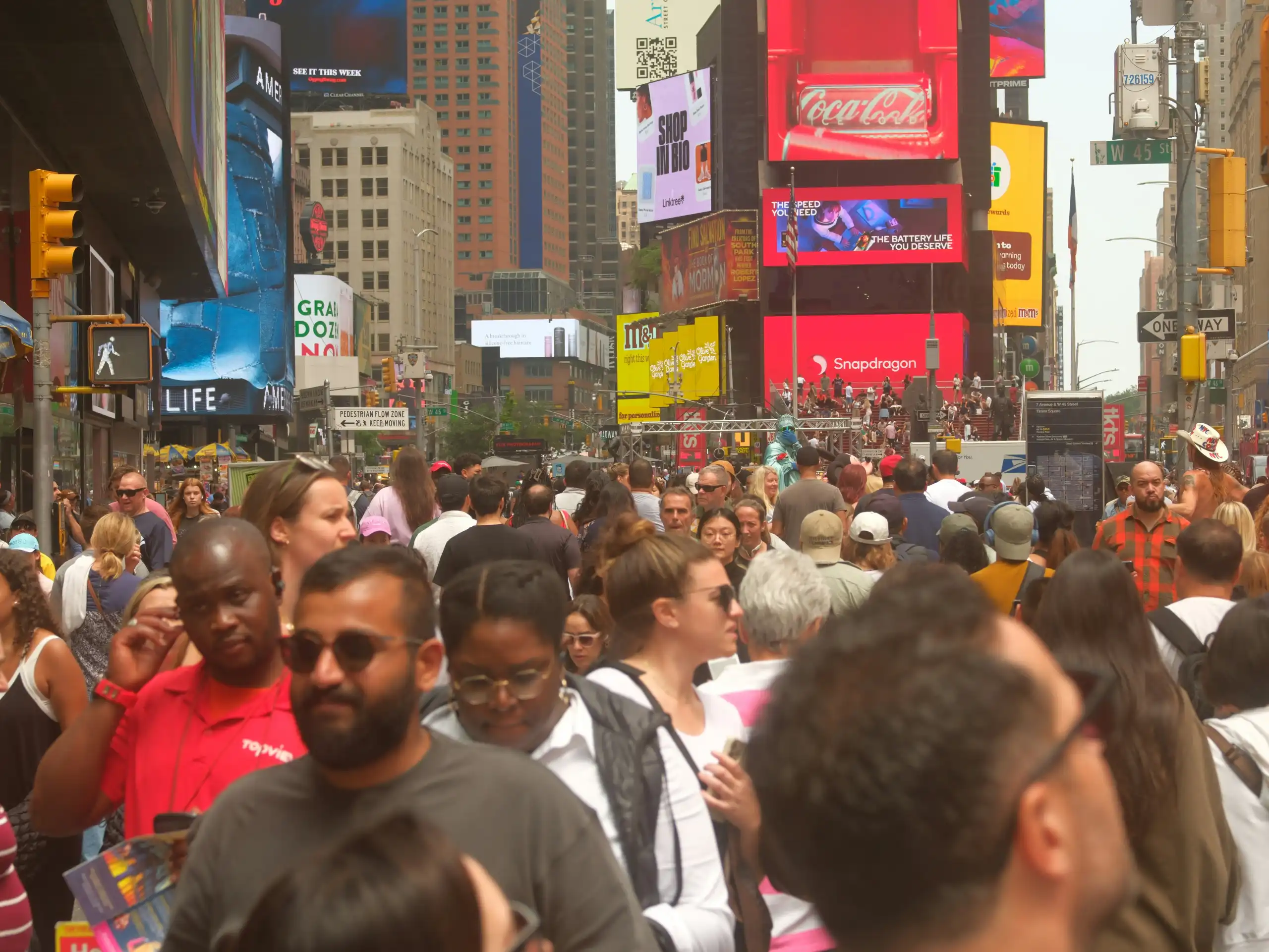
There is no official count yet of how many people left New York City in 2026. The most recent figures, the U.S. Census Bureau’s Vintage 2025 estimates, cover July 1, 2024 to July 1, 2025. In that year, 113,718 more people moved from New York City to other parts of the United States than moved in, according to the NYC Department of City Planning’s March 2026 report. Net international migration added 65,824 people and births outnumbered deaths by 36,101, so the city’s population was roughly unchanged at 8,584,629, a decline of 12,196, or 0.1%. Below I cover what those numbers include, what the data says about high earners, and what it means for Manhattan and Brooklyn buyers and sellers.
Key takeaways
- No official estimate covers 2026 yet. The latest Census figures run from July 1, 2024 to July 1, 2025.
- New York City’s net domestic outflow of 113,718 was largely offset by international arrivals and births.
- Manhattan was essentially flat, down 648 people, and Brooklyn fell by 4,694, or 0.2%.
- No source counts millionaires leaving the city in 2026, and the high-earner research points in two directions.
- In the third quarter of 2026, Manhattan closings rose 9% from a year earlier, and closings over $3 million rose 25%, according to Corcoran.
How many people left NYC in 2026?
No one can answer that with official data yet. The Census Bureau estimates population as of July 1 of each year and publishes the figures months later. The estimates for New York City’s five counties, covering July 2024 to July 2025, came out on March 26, 2026, according to the Census Bureau’s county release. As of this writing, the estimates that would cover July 2025 to July 2026 have not been released.
The figures also change after they are published. The Department of City Planning notes that the new Census method raised its estimate of the city’s July 2024 population from 8,478,000 to 8,597,000, mainly because of higher estimates of international arrivals, and that future revisions are likely. Any headline that gives an exact number of people who left in 2026 is not citing an official count.
How did NYC’s population change from 2024 to 2025?
The city lost residents to other parts of the country and gained them from abroad and from births. Here are the components of change from the Department of City Planning’s March 2026 report.
| New York City, July 1, 2024 to July 1, 2025 | People |
|---|---|
| Net domestic migration | -113,718 |
| Net international migration | +65,824 |
| Natural increase (births minus deaths) | +36,101 |
| Total population change | -12,196 |
| Population on July 1, 2025 | 8,584,629 |
Source: NYC Department of City Planning, New York City’s Population Estimates and Trends 2026 (March 26, 2026), based on Census Bureau Vintage 2025 estimates.
What changed most was international migration, not domestic departures. In the same Vintage 2025 series, net domestic migration was -93,867 from 2023 to 2024 and -113,718 from 2024 to 2025. Net international migration fell from 219,578 to 65,824 over the same two periods, which the Department of City Planning describes as a return to a level comparable to before the pandemic. For scale, the net domestic outflow was 329,532 from 2020 to 2021. The city’s July 2025 population was about 2.5% below its 2020 peak.
How did Manhattan and Brooklyn compare with the other boroughs?
Every borough had a net domestic outflow from 2024 to 2025 and net international arrivals, according to the Department of City Planning and the Cornell Program on Applied Demographics.
| Borough | Population, July 1, 2025 | Change from 2024 | Net domestic migration | Net international migration |
|---|---|---|---|---|
| Manhattan | 1,664,862 | -648 | -16,852 | +13,270 |
| Brooklyn | 2,653,963 | -4,694 | -38,847 | +17,564 |
| Queens | 2,358,182 | -8,852 | -38,449 | +20,672 |
| Bronx | 1,406,332 | +280 | -18,685 | +12,760 |
| Staten Island | 501,290 | +1,718 | -885 | +1,558 |
Source: NYC Department of City Planning (March 2026) and Cornell Program on Applied Demographics, Vintage 2025 county estimates.
How many people left New York State?
New York State’s population was 20,002,427 on July 1, 2025, up 1,008 from a year earlier, according to the Census Bureau’s January 27, 2026 release. The state had net international migration of 95,634, the fourth highest of any state. The Cornell Program on Applied Demographics puts the state’s net domestic migration for the same year at -137,586, which means New York City accounted for most of the state’s net domestic outflow.
How many millionaires left NYC in 2026?
No official source counts millionaires leaving New York City in 2026. What exists is a count of wealthy residents and state tax data through 2024.
- How many live here. Henley & Partners’ World’s Wealthiest Cities Report 2025, published April 8, 2025, ranked New York first in the world with 384,500 millionaires, including 818 centi-millionaires and 66 billionaires. A GOBankingRates summary of the report lists New York’s millionaire growth from 2014 to 2024 at 45%. I could not find a 2026 edition.
- Who left the state. The New York State Comptroller reported that in 2024, 134,913 tax filers left the state and 121,251 moved in, a net out-migration of 13,662. The highest out-migration rate was for households making $500,000 or more, at about 1%.
- The top 1%. The Fiscal Policy Institute argued on July 16, 2026 that the Comptroller’s top bracket hides a different pattern: households in the top 1%, with income around $815,000, leave New York at the lowest rates, with 2020 and 2021 the exceptions.
These figures are statewide, and none of them covers 2026. I go deeper on the high end of the market in Are the Wealthy Leaving New York City in 2026?
What does this mean for Manhattan and Brooklyn buyers and sellers right now?
The sales data is far more current than the population data. In Manhattan, The Corcoran Report for the third quarter of 2026 shows the highest third-quarter median price on record and the fewest third-quarter active listings since 2017. Closings over $3 million rose 25% from a year earlier, compared with a 6% gain below $3 million.
Brooklyn looked different. Corcoran’s Brooklyn report (October 8, 2026) shows signed contracts up and inventory up sharply, with average price per square foot flat at $1,161.
| Third quarter of 2026 | Manhattan | Brooklyn |
|---|---|---|
| Closed sales | 3,625 (up 9%) | 1,481 (down 3%) |
| Signed contracts | 2,532 (down 6%) | 884 (up 8%) |
| Median price | $1.25 million (up 4%) | $866,000 (down 1%) |
| Active listings | 6,354 (down 3%) | 2,033 (up 21%) |
| Average days on market | 90 | 71 |
Source: The Corcoran Report, Manhattan 3Q 2026, and Corcoran’s Brooklyn Real Estate Market Report: 3Q 2026.
For a Manhattan seller, fewer listings means less direct competition. For a Brooklyn buyer, more listings means more choice. I track these numbers every quarter, and I break down marketing time by price range in How Long Does It Take to Sell an Apartment in NYC?
What do I tell my clients about the “people are leaving NYC” headlines?
I tell my clients to keep two questions apart. The first is how many people moved in and out of the city, which the Census answers once a year and more than a year after the fact. The second is what their apartment is worth this month, which depends on the building, the price range, and the listings competing with it today.
A citywide average does not price a two-bedroom co-op on the Upper West Side or a townhouse in Park Slope. Closed sales, signed contracts, and active inventory in that segment do. When a client asks me whether the headlines should change their plans, I start with those numbers, and with their own timeline and finances.
I talk about what is driving demand at the top of the Manhattan market in this short video.
If you are weighing a purchase or sale in Manhattan or Brooklyn and want the numbers for your building and price range, request a confidential consultation. For my quarterly read on the market, sign up for The Franco Report, or start with my overview of the Manhattan housing market.
About the author. Michael J. Franco leads the Michael J. Franco Team at Compass and is a co-founding member of Compass’s Trusts and Estates Division. In the RealTrends Verified rankings of 2025 sales, his small team ranked No. 1 in Manhattan by number of closed sales and No. 152 in the U.S. by sales volume. He has more than 20 years of experience as a broker, attorney, and investor.
This post is for general information and is not financial, legal, or tax advice. Compass is a licensed real estate broker. Equal Housing Opportunity.
Social Cookies
Social Cookies are used to enable you to share pages and content you find interesting throughout the website through third-party social networking or other websites (including, potentially for advertising purposes related to social networking).