

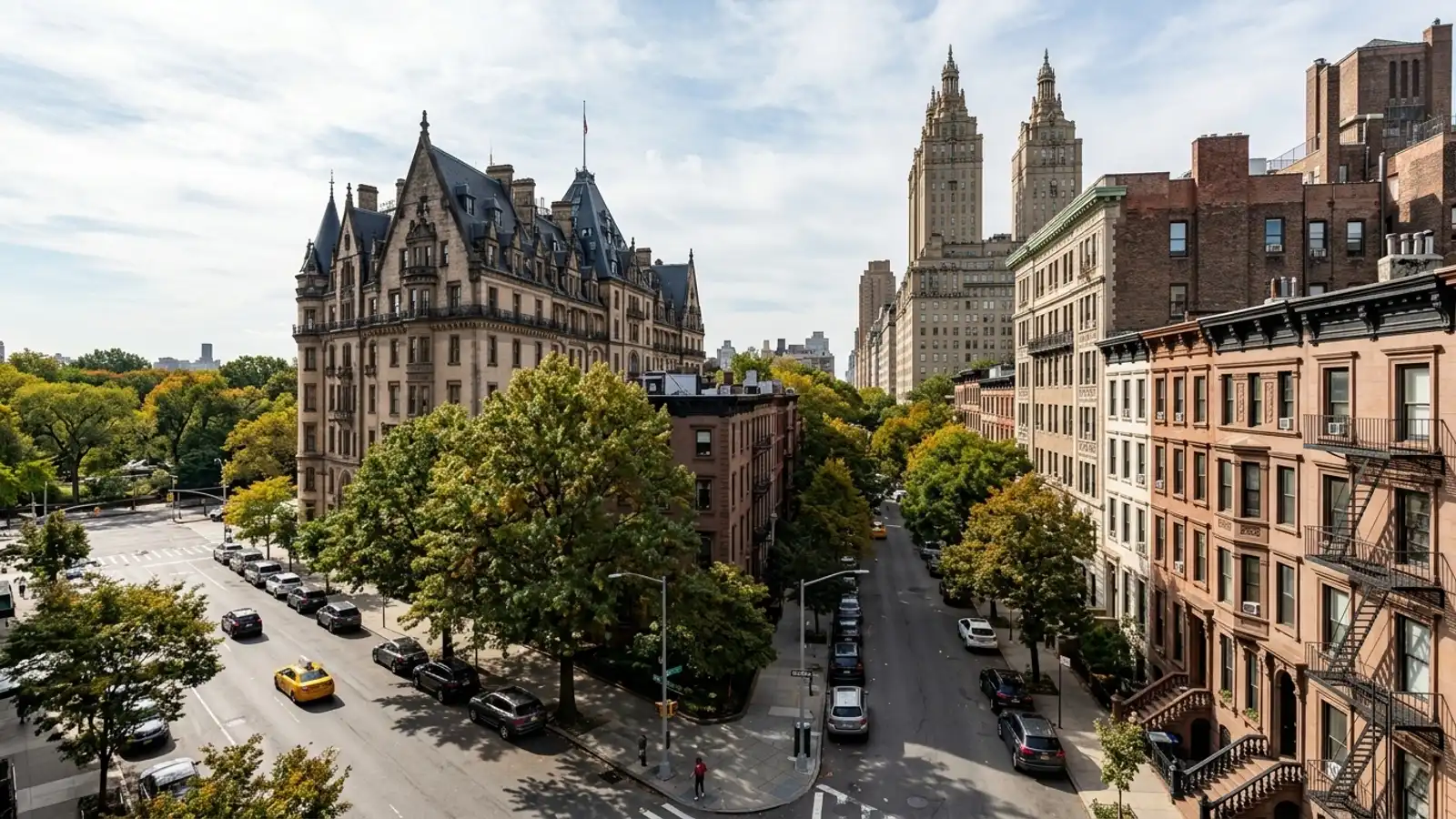
Manhattan is the core of the New York–Newark–Jersey City, NY–NJ Metropolitan Statistical Area, and it’s been anchoring the broader Tri-State area for four centuries. What started as a 17th-century Dutch trading post is now one of the most recognizable real estate markets on the planet. The pros and cons of living in Manhattan today are still influenced by this centuries-old foundation.
If you’re thinking about buying here, you already know it won’t be cheap. As of mid-2026, the median sale price for a home in Manhattan, NY sits around $1.45 million. There are roughly 5,715 available properties, and the average time on market is 84 days – so you’ll have room to look around, but you’re still paying a premium for the address no matter what you choose.
A Quick Look at Manhattan’s Origins
Manhattan was settled in 1624 when the Dutch West India Company established a trading colony on the island. The original inhabitants were the Lenape people. Two years later, in 1626, Peter Minuit purchased the island from local Native Americans – that transaction set the foundation for what would become New Amsterdam.
Geographically and politically, Manhattan is coextensive with New York County, New York. The borough and the county share the exact same borders. It operates as one of the five boroughs of New York City, not as an independent town or city of its own.
Understanding the Borough and County
Because Manhattan and New York County are the same entity, administrative functions run through the broader New York City government. If you’re pulling public records or reviewing property deeds, you’ll find them filed under New York County – that’s not a mistake. This structure has been in place since the city’s consolidation well over a century ago.
The Meaning Behind the Name Manhattan
The name Manhattan likely derives from the Lenape word “Manaháhtaan,” which translates to “the place where we get bows” – a reference to the natural resources the original inhabitants found on the island.
There’s a related term, “Mannahatta,” that carries a different translation: “island of many hills.” Centuries of development have leveled most of that original topography, but the name itself remains a record of what the land once looked like.
From Lenape Roots to Global Recognition
When the Dutch colonists arrived, they held onto the local terminology, adapting it for their own maps and records. The spelling drifted over the centuries into the modern English version we use today. The linguistic thread from Lenape to Dutch to English is still right there in the word itself, if you think about it.
The Founding and Timeline of the Island
The first European settlers were Dutch colonists sent by the Dutch West India Company in the 1620s. They built up the southern tip of the island to protect their operations, establishing the trading post of New Amsterdam. That small settlement laid out an initial street grid that you can still trace through the Financial District today.
The English took control of the area in 1664 and renamed it New York. Through the 1700s and 1800s, the population pushed steadily northward, eventually producing the famous Commissioners’ Plan of 1811 – the grid system that organized the rest of the island.
Early Settlement and Trading Post Days
In those early decades, the local economy ran on fur trading and maritime commerce. The natural harbor offered a deep-water port where ships could load and unload without difficulty. That geographic advantage is what turned a small trading outpost into a major economic center. Geography did most of the work before anyone had a plan.
Historic Districts and Landmarks Still Standing
The Upper West Side – stretching along Central Park West between West 61st and 97th Streets – is one of Manhattan’s premier historic neighborhoods. Landmark pre-war buildings like The Dakota, The Langham, and The San Remo are concentrated here, and buyers specifically seek them out for their architectural details and long-standing prestige.
If you want to understand the deeper context behind what you’re buying into, The Museum of the City of New York is worth your time. Located on Fifth Avenue, it’s dedicated entirely to the culture and evolution of the city – a solid resource for anyone doing serious research on a neighborhood’s past.
The Upper West Side and Iconic Monuments
The area isn’t defined only by its residential architecture. The Statue of Liberty, located in New York Harbor at the entrance to Manhattan, is a National Monument and one of the most recognizable historic landmarks associated with the borough. For generations of residents, it was the first thing they saw when they arrived.
What Manhattan Is Known For Today
Modern Manhattan is recognized globally for its skyline, its density, and its financial sector. It functions as the economic engine for the New York–Newark–Jersey City, NY–NJ Metropolitan Statistical Area, and the daily flow of commuters and tourists keeps that engine running at a pace that doesn’t slow down much.
Food culture is woven into the borough’s identity in a way that’s genuinely different from most places. New York-style pizza and the New York bagel are widely regarded as signature foods associated with Manhattan. You can find longstanding pizzerias and bagel shops operating in nearly every neighborhood, from the Lower East Side all the way up to Inwood.
Signature Foods and Daily Life
These culinary staples trace directly back to the waves of immigrants who arrived in the late 19th and early 20th centuries. The recipes and techniques they brought became permanent fixtures here – not trends, just the way things are done. For most residents, grabbing a slice or a bagel isn’t a special occasion. It’s Tuesday.
Frequently Asked Questions
What are the restrictions for renovating a property located in a Manhattan historic district?
Yes, there are restrictions. If you buy a home in a designated historic district – such as certain blocks on the Upper West Side – you’ll need approval from the Landmarks Preservation Commission (LPC) for any exterior changes. Interior renovations generally face fewer restrictions, but you’ll still need standard Department of Buildings permits for that work.
Do historic pre-war apartments in Manhattan generally hold higher resale value than new construction?
It depends on the specific building and location. Landmark buildings like The Dakota or The San Remo often carry a premium because of their prestige and distinctive architecture. That said, modern luxury developments also command high prices – the overall Manhattan median sale price is currently around $1.45 million, and strong numbers show up across both categories.
Are there tax incentives or abatements available for buying and restoring a historic brownstone in NYC?
Yes, certain properties may qualify for programs that reduce property taxes. Whether a specific 19th-century townhouse falls under state or federal historic preservation tax credit programs is something you’ll want to work through with a local tax professional. These incentives typically require strict adherence to historical accuracy during renovations, so go in with your eyes open.
What hidden structural issues should I look out for when buying a 19th-century townhouse in Manhattan?
Outdated electrical wiring, aging plumbing systems, and foundation settling are the main things to watch for. Many of these structures date back to the 1800s and will need updates to meet modern building codes. Get a thorough inspection before you close – that’s not optional on a property this old.
How do historical land leases, like those in Battery Park City, impact my monthly fees and property value?
Properties on land leases require owners to pay a monthly ground rent on top of standard maintenance or HOA fees, which raises your overall carrying costs. You’ll also want to review how much time is left on the lease. Values can drop significantly if the expiration is approaching and renewal terms are uncertain.
How long does it typically take to get Landmarks Preservation Commission (LPC) approval for exterior updates in Manhattan?
It depends on the scope of the work. Minor updates may qualify for faster staff-level approval, while major alterations to a historic facade require public hearings and revisions. Before you buy a landmarked property with renovation plans in mind, build this approval timeline into your projections – it’s not a formality.
Social Cookies
Social Cookies are used to enable you to share pages and content you find interesting throughout the website through third-party social networking or other websites (including, potentially for advertising purposes related to social networking).