

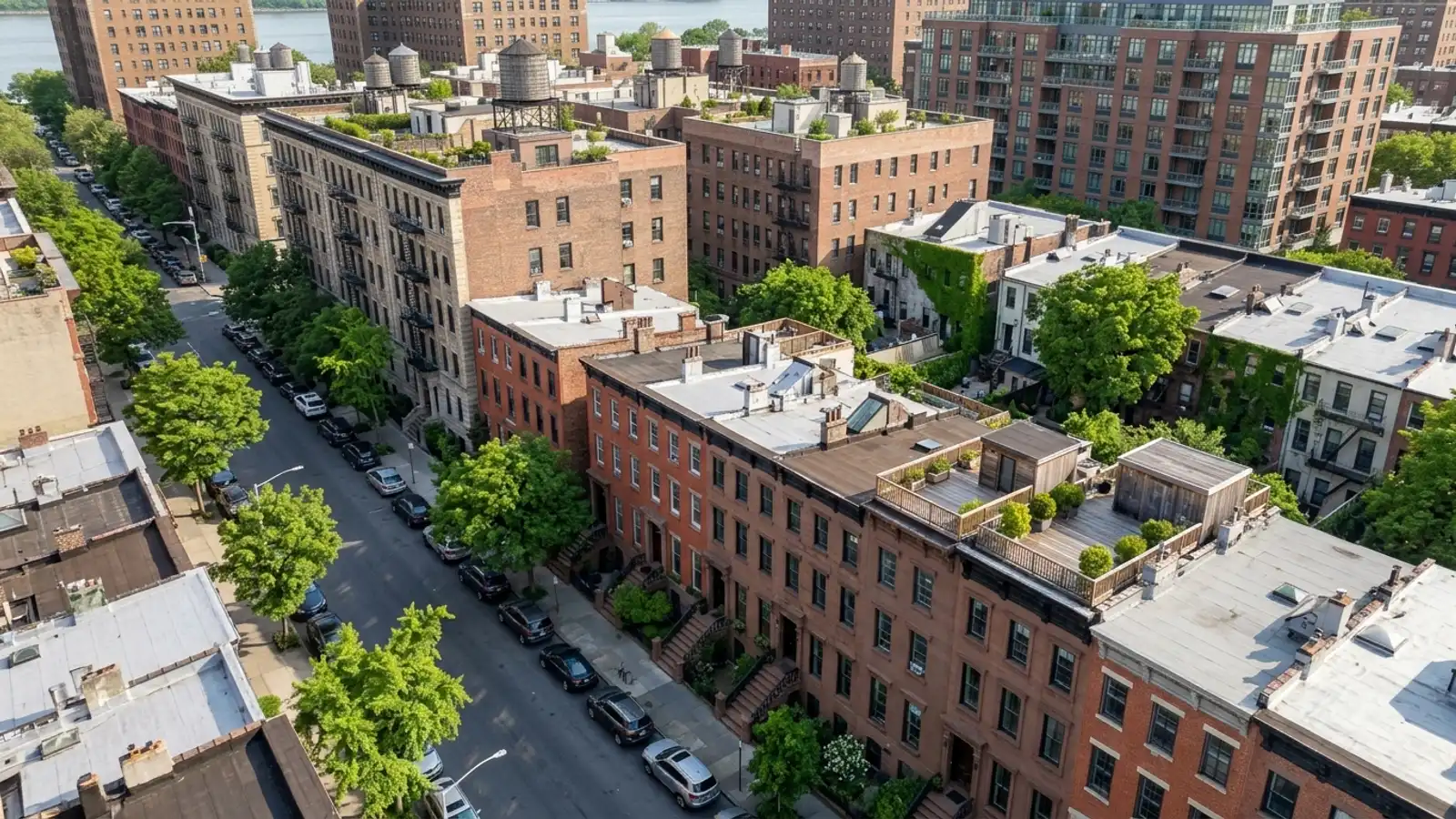
The median home price across all of Manhattan recently hit roughly $1.33 million, but that single number hides a divided market.
Key Takeaway
The most reliable way to value a Manhattan home is to check the price per square foot for your specific property type against recent sales in your own building or block, then confirm it with a comparative market analysis or appraisal. This approach works best for condos. Townhouses and single-family homes trade too rarely for a simple formula, so you should start from hand-picked comparable sales instead.
Who This Guide Is For
You own a home in Manhattan and want a realistic price range before deciding whether, when, and at what price to sell.
How Property Type Changes Your Home’s Value in Manhattan
Manhattan is not one market for sellers. It’s three distinct markets, and the numbers behave very differently depending on which one you’re in.
Condos sell in a median 69 days. Townhouses close at 100.1% of list price despite having the lowest median price per square foot at $1,310. Single-family homes sit for a median 166 days, and none sell above list price. A valuation built on the borough-wide $1,329,367 median misprices any home that isn’t a typical condo. These figures reflect Redfin data for the 90 days ending September 30, 2026.
The data doesn’t separate co-ops, so co-op owners should rely on recent sales within their own building rather than broad averages.
Manhattan Home Values by Property Type
Buyers judge a listing against what else is for sale in its own category.
Condos
About 95% of Manhattan home sales in the latest 90 days were condos: 2,707 out of 2,836 total transactions. That volume gives condos something the other property types don’t have: deep, current comparable sales and buyers who know the going rate. Valuation here is mostly about matching your unit to recent sales in the same building or line and pricing accurately against them.
The flip side of that depth is real competition. A condo priced above its building’s recent sales tends to sit while cheaper comparable units sell first.
Townhouses
Only 84 townhouses sold in all of Manhattan in the latest three months, which is fewer than one a day. A price-per-foot formula is a weak guide for these properties because width, condition, legal unit count and landmark status vary drastically from house to house. Supply sits at eight months, yet well-priced houses still sell at full asking price.
Accurate pricing is rewarded here, and ambitious pricing usually means a long wait. Confirm the legal number of units on your certificate of occupancy with the NYC Department of Buildings before setting a price. One unusual closing on your block can swing an estimate, and buyers have enough choices to wait out a house priced off the wrong comparable sale.
Single-family homes
The median sale price for single-family homes recently jumped 45.8% year over year, but that figure rests on just 38 sales. The spike most likely reflects which houses happened to sell, not a uniform gain across the category. The more telling number is supply: 11.9 months of inventory gives buyers significant bargaining power and time to be patient.
Price these homes off closed sales of genuinely similar houses. Pricing off that jump or a neighbor’s headline sale is the fastest way to overshoot, and with nearly a year of supply, an overpriced house can sit for a very long time.
How to Estimate Your Home’s Value
Start with price per square foot
Multiply your home’s size by the median price per square foot for your property type. For illustration only: a 1,000-square-foot condo multiplied by the recent condo median of $1,448 per square foot gives a starting estimate of about $1.45 million. Townhouse and single-family owners should use their own type’s figure from the at-a-glance list below, not the condo number.
This is a starting range, not a final value, and the math is only as good as your square footage. There’s no official, government-mandated standard for measuring residential square footage in New York City. If the number in your listing history or offering plan is generous, your first-pass figure will be too. Confirm your actual size from a floor plan or a professional measurement.
Adjust for what price per square foot misses
A flat formula ignores the physical realities of your home. Adjust the baseline for floor height, natural light, views and private outdoor space. Layout efficiency and the age of your renovations also affect what a buyer will offer. Monthly carrying costs, whether common charges and taxes or co-op maintenance, factor directly into a buyer’s budget, and buyers compare them against competing units.
For co-ops, account for board approval difficulty and financing rules. Ask your managing agent for current monthly charges and whether any assessments are planned, and read your proprietary lease or bylaws for a flip tax that will affect your net proceeds.
Adjustments are judgment calls, and owners tend to value their own renovations more than buyers do. Treat each upward adjustment as something you’ll need a comparable sale to defend.
Check recent sales in your building or block
Pull your own comparable sales from public records to ground your estimate. Manhattan sale prices are public: you can look up recorded sales by address in the city’s ACRIS system. The NYC Department of Finance’s Rolling Sales dataset covers recorded sales citywide over the prior twelve months and updates around the 15th of each month.
Recorded sales lag actual closings, and public records show the final price but not the property’s condition or any seller concessions. A comparable sale that looks low might have been a gut renovation project, and a very recent closing may not appear in the system yet.
Get a CMA or an appraisal
A comparative market analysis (CMA) from a real estate agent is free and built specifically to help you set a competitive list price. Michael J. Franco’s team at Compass can prepare a CMA for your home to help you understand its current market position. An appraisal from a New York-licensed appraiser is a formal opinion of value required for a lender, an estate, a divorce or a tax matter. You can verify an appraiser’s license through the New York State Department of State’s public search system.
A CMA is an opinion, not a guarantee, and a buyer who finances will face an appraisal ordered by their lender. If that appraisal comes in below your contract price, the gap can reopen negotiations.
Manhattan Housing Market Conditions for Sellers
Borough-wide conditions set how much bargaining power you hold. Median sale prices rose a modest 3.4% year over year across all homes. A list price built on last year’s comparable sales plus a few percent is generally defensible. Anything priced well above that needs a specific, tangible reason.
With about 6.1 months of overall supply on the market, buyers have time to compare your home against the competition. If you need to sell by a set date, price at the comparable sales from day one rather than planning to cut later. Reach out to request a CMA when you’re ready to pinpoint your exact list price. Review the broader steps for selling a home in Manhattan as you prepare to enter the market.
Manhattan Home Values at a Glance
- All homes: median sale price $1,329,367, up 3.4% year over year (90 days ending Sept. 30, 2026)
- All homes: 2,836 sales, median 70 days on market, 99.5% sale-to-list, 14% sold above list (90 days ending Sept. 30, 2026)
- All homes: 5,660 homes for sale, 6.1 months of supply, median $1,442 per sq ft (90 days ending Sept. 30, 2026)
- Condos: median sale price $1,274,869, up 4.1% year over year, median $1,448 per sq ft, 2,707 sales (90 days ending Sept. 30, 2026)
- Condos: median 69 days on market, 99.5% sale-to-list, 14.2% sold above list, 5.8 months of supply, 5,140 for sale (90 days ending Sept. 30, 2026)
- Townhouses: median sale price $2,385,028, down 0.6% year over year, median $1,310 per sq ft, 84 sales (90 days ending Sept. 30, 2026)
- Townhouses: median 84 days on market, 100.1% sale-to-list, 14.6% sold above list, 8 months of supply, 219 for sale (90 days ending Sept. 30, 2026)
- Single-family homes: median sale price $6,172,539, up 45.8% year over year, median $1,494 per sq ft, based on only 38 sales, so treat the change with caution (90 days ending Sept. 30, 2026)
- Single-family homes: median 166 days on market, 98.9% sale-to-list, 0% sold above list, 11.9 months of supply, 146 for sale (90 days ending Sept. 30, 2026)
Figures are Redfin data and describe sales across all of Manhattan, not any one building.
Manhattan Property Valuation FAQs
How much is all the property in Manhattan worth?
The final fiscal year 2027 assessment roll, released by the NYC Department of Finance on May 26, 2026, set Manhattan’s total market value at approximately $545.2 billion, slightly below the tentative $545.8 billion. It’s a tax-roll figure used to calculate property taxes, not an estimate of what those properties would sell for.
How accurate are online home value estimates in Manhattan?
Zillow reports a nationwide median error rate of 1.77% for homes on the market and 7.20% for off-market homes. Co-ops and one-of-a-kind townhouses are especially hard to estimate because they have fewer comparable sales, so check any online figure against recorded sales in your building.
Is the market value on my NYC property tax bill what my home would sell for?
The market value on your tax bill is usually well below your home’s sale value. The city values condos and co-ops as if they were rental buildings, and for one- to three-family homes, assessed value growth is capped at 6% per year and 20% over five years regardless of market growth. The tentative assessment roll comes out each year on January 15, after which the city sends your Notice of Property Value.
How much does a home appraisal cost in Manhattan?
Costs vary with your property’s type and size and the purpose of the valuation, such as a mortgage, estate or divorce. Ask two or three licensed appraisers for written fee quotes rather than relying on a standard rate.
Does selling a co-op in Manhattan require an appraisal?
It depends on how your buyer pays. A buyer with a mortgage will typically face a lender-ordered appraisal, while an all-cash sale may not need one. Co-op boards set their own financial requirements, so ask your managing agent for the board’s purchase application requirements.
What closing costs reduce a seller’s proceeds in Manhattan?
Sellers pay the NYC Real Property Transfer Tax: 1% of the price at $500,000 or less, and 1.425% of the full price when it is above $500,000. For residential sales of $3 million or more, a combined New York State transfer tax rate of 0.65% also applies. Add any co-op flip tax in your proprietary lease and your broker’s commission, which you negotiate directly with your agent.
Sources
- Redfin: Data Center
- NYC Department of Finance: ACRIS
- NYC Open Data: Citywide Rolling Calendar Sales
- Coldwell Banker Warburg: Measure for Measure
- MGNY Consulting: Manhattan Property Tax
- Help New York: NYC Property Tax Classes 1-4 Explained
- NYC Department of Finance: FY24 Tentative Assessment Roll
- New York State Department of State: Real Estate Appraiser
- Next Step Lawyer: Who Pays the Transfer Tax in NYC?
- Benjamin Taylor: Understanding NYC and NYS Real Estate Transfer Taxes
Social Cookies
Social Cookies are used to enable you to share pages and content you find interesting throughout the website through third-party social networking or other websites (including, potentially for advertising purposes related to social networking).