

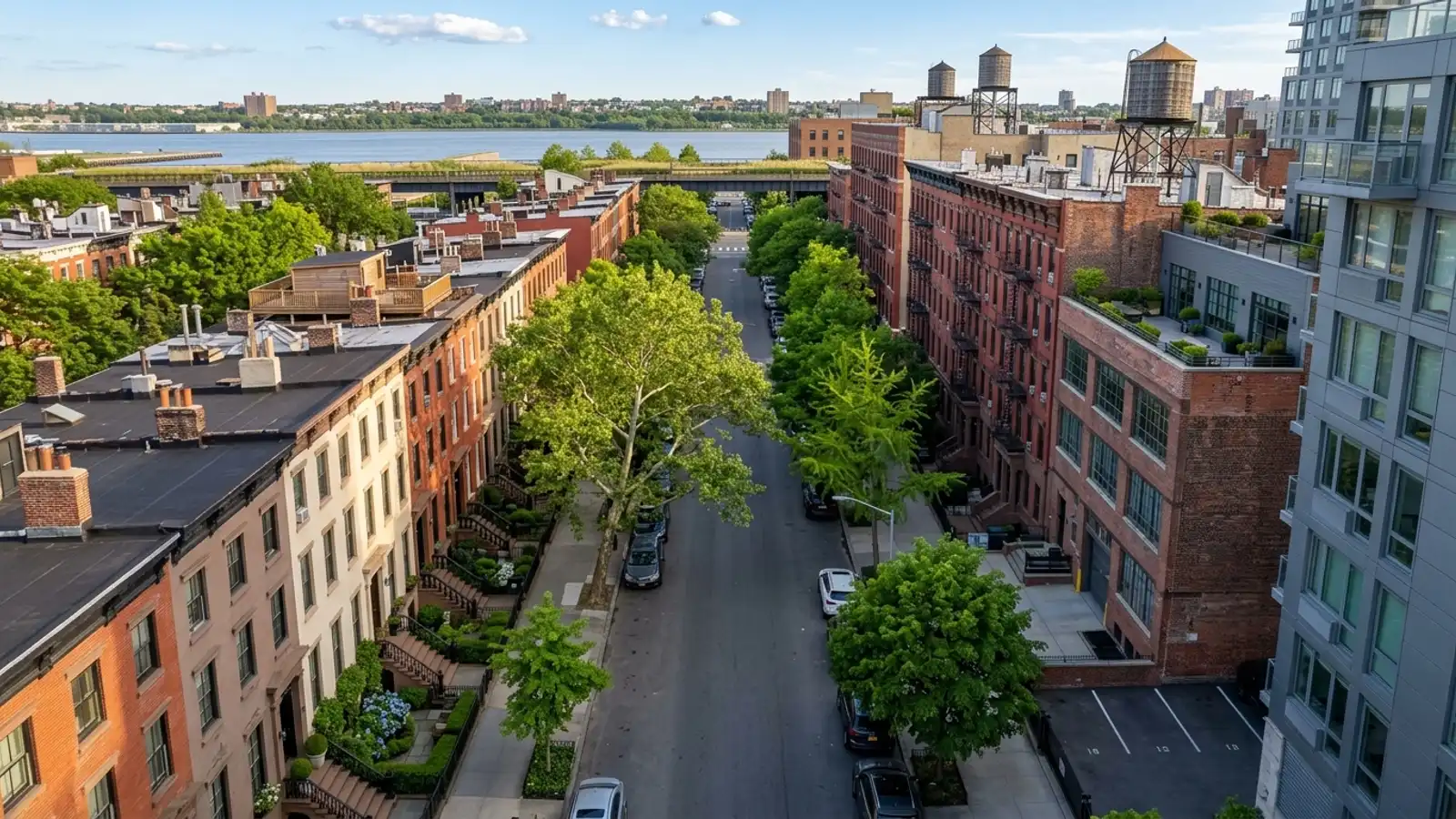
Chelsea sits on the west side of Manhattan, NY – roughly 14th Street to 34th Street, with the Hudson River to the west and Sixth Avenue to the east. Many consider it one of the best neighborhoods in Manhattan. It’s a dense, walkable stretch of the city where pre-war architecture and repurposed industrial buildings share the same block, sometimes the same street.
The pricing reflects the address. Manhattan’s overall median sale price sits around $1.31 million, but in Chelsea you’re typically looking at $1.7 million to $1.9 million. The inventory is a mix of pre-war co-ops, modern condominiums, and historic townhouses – and each of those comes with its own set of rules, costs, and considerations.
What to Expect When Living in Chelsea, Manhattan
The neighborhood mixes large residential complexes with mid-rise blocks and former commercial buildings converted to housing. The 1930 Neo-Gothic London Terrace Towers takes up an entire city block – a useful landmark for understanding the scale of what gets built here.
The High Line cuts right through the middle of it. That’s the 1.45-mile elevated public park built on a 1930s freight rail line, opened as green space in 2009, and it’s changed how people move through the neighborhood. Chelsea Market sits just below it, operating out of the old 1890s National Biscuit Company factory building.
The Layout and Housing Setting
East-west streets are mostly residential – townhouses, mid-rise apartment buildings, the quieter parts of the grid. The north-south avenues handle commercial traffic, retail, and the larger residential towers.
The historic Hotel Chelsea, built in 1883 and on the National Register, stands on West 23rd Street. That central corridor roughly divides the neighborhood’s lower and upper halves, each with its own concentration of galleries, retail, and residential blocks.
Connecting to the Rest of the City
Chelsea borders the West Village to the south and Hell’s Kitchen to the north. The Hudson River Park greenway runs along the western edge – a continuous path for walking or cycling down toward Lower Manhattan without a single traffic light to negotiate.
Multiple subway lines run under the major avenues. The neighborhood sits centrally enough on the west side that Midtown and the Financial District are both within reasonable reach.
Real Estate Options and Pricing
Manhattan recently had roughly 4,100 available homes and a median time on market of 73 days. Chelsea moves at a similar pace, though you’re starting from a higher price floor than the borough average.
Co-ops make up a significant portion of the local market, and their boards operate on their own terms. Post-closing liquidity requirements, debt-to-income ratios that go well beyond what a standard mortgage lender would ask for – these aren’t negotiable, and they catch buyers off guard more often than you’d expect.
Home Types and Property Attributes
Along the High Line and the western avenues, you’ll find newer luxury condominiums – doormen, modern amenities, higher monthly common charges. East of Tenth Avenue, the inventory shifts toward more traditional Manhattan housing: walk-up buildings and mid-century co-ops where you own shares in a building corporation rather than the unit itself.
The brownstones and pre-war co-ops give Chelsea its character. The condos give it most of its price ceiling.
Price Ranges Compared to the Manhattan Median
The Chelsea median runs $1.7 million to $1.9 million as of mid-2026, against a broader Manhattan median of approximately $1.31 million. Condominiums skew that number higher – some recent reports put the median condo price around $2.2 million.
Monthly maintenance fees and HOA dues vary depending on the building’s age and what amenities it’s carrying. That number matters as much as the purchase price when you’re running the math.
Daily Life, Dining, and Getting Around
Most daily errands happen on foot here. Eighth and Ninth Avenues carry a high density of grocery stores, pharmacies, and specialty shops, and very few residents are more than a few blocks from what they need on any given day.
Chelsea Market handles both the food hall experience and a lot of the grocery shopping. The side streets fill in with independent cafes, bakeries, and neighborhood service businesses – the kind of block-level commerce that makes a dense neighborhood function day to day.
Everyday Dining and Local Shopping
Ninth Avenue is the primary restaurant row. It runs a dense concentration of dining options that serves both daytime office workers and the surrounding residential population. The range is wide – casual bodegas and diners up through higher-end restaurants.
Multiple large-scale grocery stores serve the area, including national chains and local specialty markets. It’s one of the more food-accessible parts of the city, which for a lot of buyers is a practical factor, not just a nice-to-have.
Transit and Local Routes
The A, C, E, 1, 2, and 3 lines run through the neighborhood. The L train originates at 14th Street and Eighth Avenue and runs directly crosstown into Brooklyn.
MTA bus routes cover uptown and downtown service on the avenues, with crosstown buses on 14th, 23rd, and 34th Streets. For anyone driving out of the city, the West Side Highway runs along the Hudson River edge.
Schools, Healthcare, and Weather
Public services and medical facilities in Chelsea don’t sit on campuses – they’re woven directly into the streetscape, which is typical for this part of Manhattan. The Chelsea Manhattan weather is standard New York City: four real seasons, warm and humid summers, cold winters with occasional snow, and buildings that need to take heating seriously.
School District Boundaries
Chelsea falls within New York City Community School District 2, a large district that covers a broad portion of Manhattan – the Upper East Side, Chelsea, and Tribeca among other areas.
P.S. 33 Chelsea Prep runs Pre-K through fifth grade and is located at 281 9th Avenue. The district also includes middle and high school options such as the Institute for Collaborative Education, Landmark High School, Liberty High School Academy for Newcomers, and Chelsea Career and Technical Education High School.
Hospitals and Medical Care
Mount Sinai’s Blavatnik Family Chelsea Medical Center at 325 West 15th Street operates as an outpatient center focused on cancer care and gynecologic oncology. For emergency services, Lenox Health Greenwich Village – in the adjacent West Village – provides an ER and urgent care.
Broader hospital access comes from Mount Sinai West in Hell’s Kitchen, NYC Health + Hospitals/Bellevue downtown, and NewYork-Presbyterian facilities serving the surrounding area.
Buying or Renting a Home
Manhattan currently carries around 4.4 months of supply, which indicates a balanced pace. In Chelsea, the median time on market is 73 days – enough time to be deliberate, not enough to be slow.
StreetEasy is the dominant search platform for New York City specifically. Zillow, Realtor.com, and Redfin carry Chelsea inventory as well, and local platforms like CityRealty and RentHop are worth having open alongside them.
Working with a Local Real Estate Agent
Co-op board packages are their own project. Tax returns, employment verification, detailed asset statements – an agent who knows Manhattan co-op boards will have seen what gets approved and what doesn’t, and that context matters when you’re putting the package together.
The difference in closing costs between condos and co-ops is also something buyers frequently underestimate. Condominiums require title insurance and mortgage recording taxes; co-ops do not. That changes the upfront cash picture.
Frequently Asked Questions
What is Chelsea in Manhattan known for?
The district operates as a major cultural hub, heavily defined by the hundreds of contemporary art galleries clustered in the West 20s. This creative sector sits directly alongside heavy foot traffic from nearby tech offices, giving the local streets a distinctly busy, mixed-use energy.
What are homes like in Chelsea Manhattan, and what do they cost?
High-density vertical living defines the local market, offering a stark contrast to the single-family detached homes found outside the city center. Securing one of these units requires a much higher upfront cash position than many other boroughs demand, as building boards strictly enforce exact debt limits and reserve minimums.
What restaurants and dining are in Chelsea Manhattan?
Residents rely on the main avenues for daily meals, where national supermarkets sit alongside independent bodegas and high-end bistros. The sheer volume of foot traffic from nearby office buildings ensures most eateries stay open from early morning coffee hours straight through late-night dinner service.
What is the weather like in Chelsea Manhattan?
Expect coastal humidity to amplify the summer heat, pushing many residents toward air-conditioned indoor spaces from June through August. Winter brings freezing temperatures that demand robust heating systems, especially in the neighborhood’s older, poorly insulated industrial conversions.
What hospitals and medical care are near Chelsea Manhattan?
Healthcare access is highly localized, meaning you can walk to specialized outpatient centers or urgent care clinics without leaving the district. For major surgeries or comprehensive inpatient treatments, residents typically travel a few neighborhoods north or south to the larger Manhattan hospital campuses.
What is the typical process and timeline for buying an apartment in Chelsea Manhattan?
Prepare for a lengthy approval phase if you pursue a unit in an older building. Gathering years of tax returns, asset statements, and personal references often takes longer than the initial property search itself, requiring tight coordination with your agent and mortgage lender.
What are common pitfalls to avoid when searching for a home in Chelsea Manhattan?
Many buyers focus solely on the list price and fail to account for the heavy upfront cash demands of older housing stock. Overlooking the absence of standard mortgage recording taxes on certain properties can also drastically alter your closing cost estimates.
Social Cookies
Social Cookies are used to enable you to share pages and content you find interesting throughout the website through third-party social networking or other websites (including, potentially for advertising purposes related to social networking).