

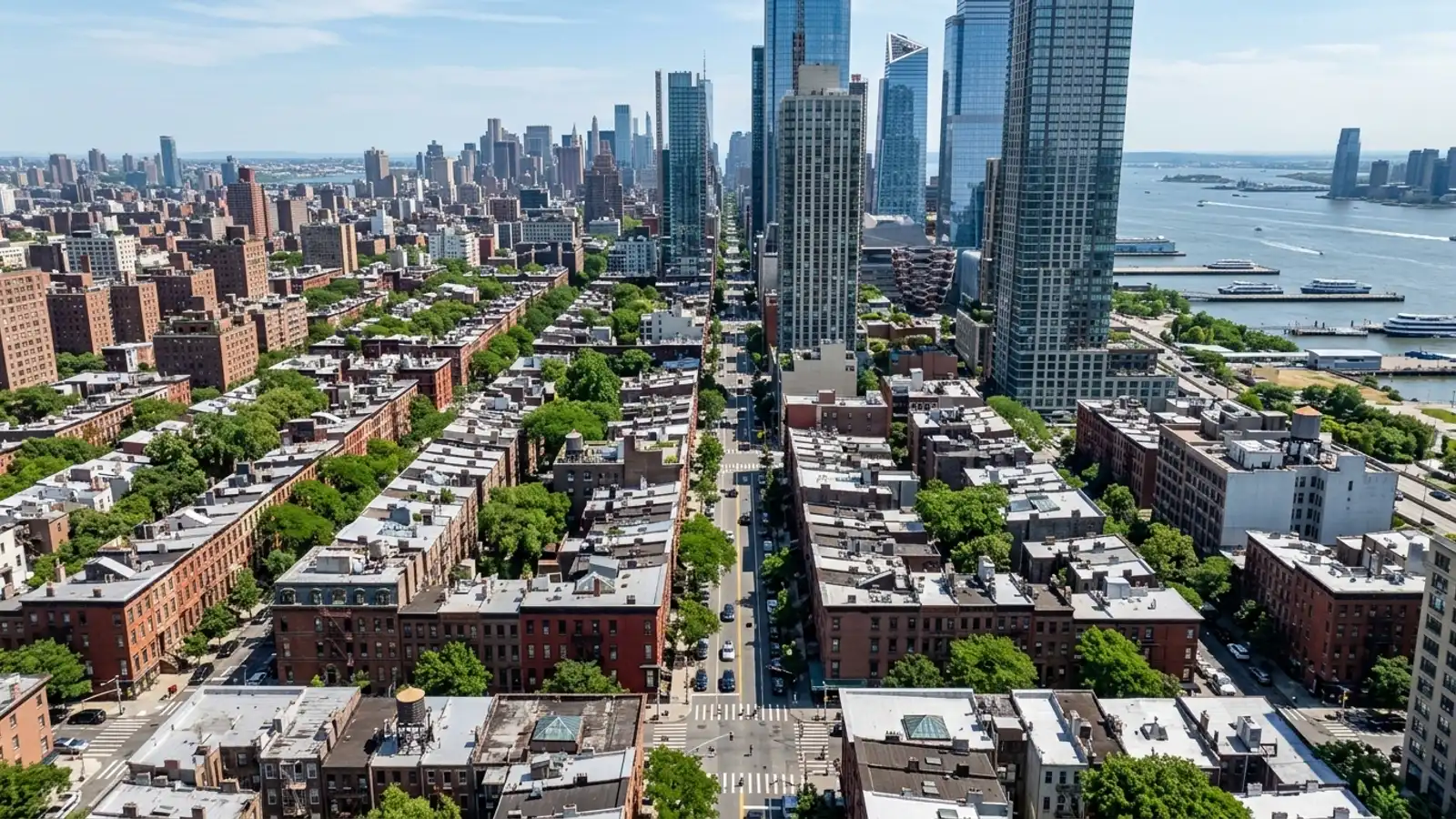
Manhattan’s real estate market is genuinely complex – thousands of options, from historic brownstones to sky-high luxury condos, spread across a narrow island where one block can feel entirely different from the next. As of mid-2026, you’re looking at a median sale price of roughly $1,450,000, with around 5,715 homes available on the market.
Where you buy matters as much as what you buy. Different areas have completely different housing stock, price points, and commute times, and lumping them together doesn’t help you. This guide breaks down the borough’s layout so you can focus your search.
Overview of Manhattan’s Layout
Manhattan is part of New York City and shares its boundaries with New York County. The island runs north to south through dozens of distinct neighborhoods, and while that sounds orderly, it can feel overwhelming until you have a framework for thinking about it.
Real estate agents and locals divide the borough into a few broad regions – not because the lines are always crisp, but because the building types and travel times to major commercial centers genuinely shift as you move through them.
Regions from Downtown to Uptown
Downtown, or Lower Manhattan, covers everything below 14th Street. Midtown spans roughly from 14th or 34th Street up to 59th Street.
Uptown includes the Upper East Side and Upper West Side above 59th Street. Upper Manhattan covers the neighborhoods above 96th to 110th Street – Harlem, Washington Heights, and Inwood among them.
New York County Context
The borough operates as its own county within the state of New York, and real estate records, property taxes, and zoning all fall under New York City and New York County agencies.
If you’re coming from out of state, the ownership structures here will likely be unfamiliar. Co-ops and condos are not the same thing, and under New York law they have different closing procedures and different rules. Worth understanding before you fall in love with a listing.
Map of Manhattan Neighborhoods
A map is the fastest way to understand how these areas connect. Central Park is the borough’s most useful geographic anchor – 843 acres running from 59th Street to 110th Street, splitting the east and west sides of Uptown.
Neighborhood boundaries can blur in conversation, but official zoning and historic district lines are fixed. When you’re targeting a specific property type, confirm the exact street boundaries rather than relying on general impressions.
Interactive Neighborhood Map
A digital map lets you filter listings by neighborhood lines, from Marble Hill in the north down to the Financial District at the southern tip. You can see how close a specific block sits to major subway lines – and that matters, because commute times shift noticeably depending on your proximity to express train stops.
Waterfront areas and properties bordering major parks are particularly worth pinpointing on a map before you drive out to see them. A building that looks close on paper can involve a longer walk than you’d expect.
Neighborhood List by Area
Upper Manhattan includes Inwood, Washington Heights, Hudson Heights, and several sections of Harlem – West Harlem, Hamilton Heights, Central Harlem, and East Harlem. Uptown features Morningside Heights, the Upper West Side, the Upper East Side, Yorkville, and Carnegie Hill.
Midtown encompasses Hell’s Kitchen, Chelsea, Hudson Yards, Murray Hill, Kips Bay, Gramercy Park, and Turtle Bay. Downtown covers Chinatown, Little Italy, SoHo, NoHo, Greenwich Village, the East Village, the Lower East Side, Tribeca, and the Financial District.
Manhattan Neighborhoods by Home Type and Price
The borough’s housing stock is mostly prewar and postwar co-op and condo apartment buildings. High-rise towers define certain sections; low-rise historic rows define others. Knowing which areas carry the architecture you want saves you from wasting time on listings that will never suit you.
Co-ops, Condos, and High-Rises
Midtown and Uptown have the highest concentration of high-rise luxury condo and co-op buildings. The Upper East Side and Upper West Side are particularly known for elegant pre-war co-op buildings lining the avenues – and those co-ops tend to have strict purchasing rules around down payments and financial reserves, which affects your timeline.
Downtown is a different mix: pre-war lofts with exposed brick, newer luxury high-rises, and converted industrial spaces. If you want that kind of character, Downtown is where to look.
Historic Districts and Brownstones
If you’re after a brownstone or a townhouse row, you need to shop in specific enclaves – this isn’t inventory you’ll find everywhere. The NYC Landmarks Preservation Commission has designated numerous historic districts across the borough.
Downtown historic districts include the Greenwich Village Historic District, SoHo-Cast Iron Historic District, and the Tribeca East, North, and West districts. Other preserved areas include the Chelsea Historic District, Gramercy Park Historic District, and the Central Harlem–West 130th-132nd Streets Historic District.
New Construction and Mega-Developments
Hudson Yards on the far West Side is the borough’s largest active new-construction hub – a 28-acre, $25 billion mega-development with residential towers at 10, 30, 50, and 55 Hudson Yards.
It’s still growing. A planned $12 to $13 billion expansion will add an 80-story residential tower and a new park over the western rail yards. Buyers who want brand-new amenities and don’t mind the construction-site energy of an evolving neighborhood tend to focus here.
Neighborhood Profiles
Each neighborhood has its own combination of home styles, typical sale prices, and proximity to major amenities. Values shift block by block depending on building type, commute access, and what’s at street level – which is exactly why a neighborhood-level summary only gets you so far.
What moves the needle is how a specific address fits your daily routine. Commute times, building types, and local retail corridors all matter, and they don’t average out neatly across a neighborhood.
Central Park and Waterfront Anchors
Central Park is the borough’s most recognizable anchor, dividing the Upper East Side from the Upper West Side. Direct park views carry a real price premium – that’s not an abstract concept here, it shows up clearly in the numbers.
Along the Hudson River and East River, waterfront neighborhoods offer greenway access and their own distinct building styles. If outdoor space is a priority, the perimeter neighborhoods are worth a closer look.
Proximity to Commercial Submarkets
Your commute is only as good as where your home sits relative to the major business districts. Midtown is the traditional office core. Midtown South – Flatiron, NoMad, Union Square – commands top commercial rents and draws heavy daily traffic. Downtown has the Financial District; Uptown office demand concentrates along the Upper East Side’s Lexington Avenue corridor.
Map your route to whichever hub matters to you before you make an offer.
Cost of Living and the Housing Market
Buying in Manhattan means understanding the full financial picture, not just the purchase price. The median household income here sits around $103,931 per year, according to Census data – but monthly maintenance fees, property taxes, and general living expenses vary widely by building and neighborhood, and they add up.
Median Home Prices and Local Costs
As of mid-2026, the median home sale price in Manhattan is roughly $1,450,000, and properties are spending about 84 days on the market before selling. That number covers an enormous range – a historic townhouse in Greenwich Village and a one-bedroom co-op in Washington Heights are both in this market, and their price profiles look nothing alike.
Researching Crime Data and Schools
For crime data, the official source is the New York City Police Department’s CompStat and open-data crime maps. Precinct-level and citywide crime complaint datasets are available through the NYC Open Data portal.
For school planning, the borough is divided into six geographic NYC Department of Education Community School Districts, running from District 1 in the Lower East Side up through District 6 in Washington Heights and Inwood. Boundaries are set by exact address, so you’ll need to check the official NYC DOE attendance-zone maps for any specific property – general neighborhood assumptions won’t cut it.
Finding a Home in Manhattan
With roughly 5,715 homes available, there’s inventory to work with. The challenge isn’t finding listings – it’s understanding board requirements for co-ops and condos, which can make a purchase feel slower and more complicated than buyers expect coming from other markets.
Narrowing your preferred neighborhoods early genuinely helps. Working through listing descriptions and building rules takes time, and having a shorter list of target areas keeps the process from becoming unmanageable.
Renting vs. Buying
Some buyers choose to rent in a neighborhood for a year before committing to a purchase. It’s a reasonable way to test a commute and get familiar with the local building inventory before locking in.
Buying does lock in your housing costs and builds equity in a major global market. The trade-off is real upfront cost – closing expenses and down payments here aren’t small numbers. Your long-term plans should drive that decision.
Working with a Local Agent
An agent who knows these specific neighborhoods can help you prepare board packages, negotiate offers, and understand the pricing difference between a pre-war co-op and a new-construction condo. They also track which buildings have upcoming assessments or purchasing rules that could complicate your timeline.
It’s not a luxury. In this market, it’s just how the process works.
Frequently Asked Questions
What are the most affordable neighborhoods to buy a home in Manhattan, NY?
Upper Manhattan neighborhoods like Washington Heights and Inwood typically offer lower entry prices than Midtown or Downtown. The borough’s overall median sale price is roughly $1,450,000, so buyers seeking lower price points should explore inventory north of 96th Street.
Which Manhattan neighborhoods are considered best for families looking for good schools and green space?
Buyers prioritizing green space often look at the Upper West Side and Upper East Side, which border the 843-acre Central Park. For school zoning, you must check the exact address against the NYC Department of Education boundary maps, as the borough is divided into six distinct Community School Districts.
Which emerging neighborhoods in Manhattan are currently seeing the highest real estate appreciation?
Hudson Yards on the far West Side remains the borough’s largest active new-construction hub, driving significant real estate activity. This 28-acre mega-development continues to expand with new residential and commercial towers, influencing surrounding property values.
Are there specific Manhattan neighborhoods where it is easier to find a condo rather than a strict co-op?
Yes. While pre-war co-ops dominate areas like the Upper East Side and Upper West Side, Midtown and new-construction hubs like Hudson Yards feature a higher concentration of condos. Downtown neighborhoods such as Tribeca and SoHo also offer loft-style condo conversions.
Which trendy Manhattan areas have hidden buyer drawbacks like extreme nighttime noise or tourist crowds?
Neighborhoods that serve as major commercial submarkets, like Midtown and the Financial District, draw significant daily commuter traffic. Midtown South areas like Flatiron and Union Square command the highest commercial rents, which means these blocks are busy business hubs rather than quiet residential enclaves.
How do downtown Manhattan neighborhoods compare to uptown when looking for a quiet residential feel?
Downtown areas mix pre-war lofts, exposed brick, and converted industrial spaces with luxury high-rises. Uptown neighborhoods like the Upper East Side and Upper West Side offer elegant pre-war co-op buildings lining the avenues alongside Central Park – a different architectural scale entirely.
Social Cookies
Social Cookies are used to enable you to share pages and content you find interesting throughout the website through third-party social networking or other websites (including, potentially for advertising purposes related to social networking).