

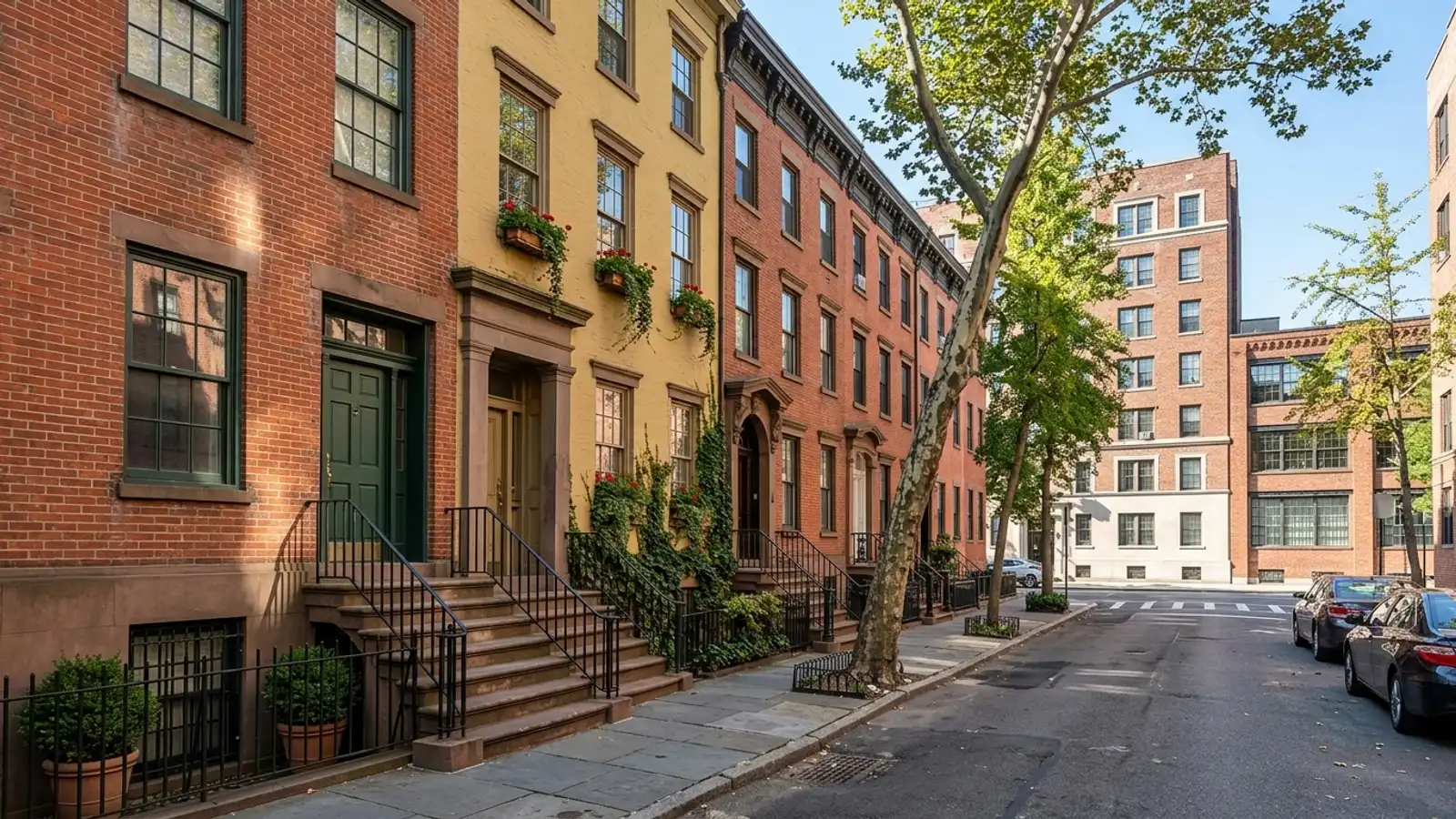
Manhattan buyers searching downtown real estate often find themselves going back and forth between Greenwich Village and the West Village. Many consider these two areas to be among the best neighborhoods in Manhattan. Outsiders sometimes treat the names as interchangeable. They’re not – the two areas have different street layouts, different housing mixes, and different daily rhythms.
Borough-wide, the Manhattan, NY median home sale price sits around $1.31 million, with properties spending roughly 73 days on the market. Buyers focused on these two downtown neighborhoods will find prices hovering near or slightly above that figure, depending on the property type.
The decision comes down to two things: where exactly the boundaries fall, and what kind of building you want to live in.
Where Does Greenwich Village End and the West Village Begin?
Most locals and real estate listings use Seventh Avenue as the dividing line – Greenwich Village to the east, West Village to the west. That’s the cleanest answer, though it’s not the only one.
Greenwich Village runs from 14th Street down to Houston Street, bounded by Broadway on the east and the Hudson River on the west. The West Village occupies the western half of that footprint, ending at Seventh Avenue. Some historical maps push the West Village’s eastern boundary out to Sixth Avenue or Greenwich Avenue, and the southern border is similarly fluid – some listings cut it off at Christopher Street, others extend it south to Houston Street.
Real Estate Markets and Housing Types
Manhattan currently has about 4,100 homes for sale. Downtown, you’re looking at pre-war co-ops, townhouses, and a relatively thin condo supply. Both neighborhoods run on co-op inventory, though the exact breakdown shifts block by block.
In Greenwich Village, co-ops make up approximately 64% of active listings. The West Village is close behind at roughly 61%.
Home Prices and Recent Trends
Median sale prices in both areas track closely with Manhattan’s borough-wide median of $1.31 million, though not perfectly. West Village data from earlier this year put the median home sale price around $1.2 million, translating to roughly $2,545 per square foot. Greenwich Village tends to run a bit higher depending on the reporting window – recent neighborhood-level data shows median sale prices ranging from $1.32 million up to $1.44 million over a 90-day period.
Property type moves the needle considerably. West Village townhouses recently hit a median of nearly $1.6 million. Condos in the area can push the median past $2.6 million, largely because supply is so limited.
Condos, Co-ops, and Townhouses
Greenwich Village has the larger pre-war apartment layouts and higher overall co-op volume. Building scale is generally taller here, particularly along the main avenues.
The West Village leans on brownstones and townhouses. Landmark restrictions make new ground-up construction rare, so most of the condo supply comes from post-1980 conversions. Co-op transactions routinely outnumber condo sales by a two-to-one margin.
Transit Access and Street Layouts
Which side of Seventh Avenue you land on changes how you move around the city in ways that aren’t obvious until you’ve lived with it. Greenwich Village sits on the traditional Manhattan grid, so getting around is straightforward. The West Village doesn’t – the streets run at an angle to the rest of the city, creating irregular intersections and shorter blocks.
That’s not a complaint or a compliment. It’s just something to know before you start touring.
Subway Lines and Commuting Options
Greenwich Village functions as a genuine transit hub. The West 4th Street station alone connects to the A, B, C, D, E, F, and M lines. The N, Q, R, and W lines run under Broadway near 8th Street, and the L train covers the northern edge of the neighborhood along 14th Street. Midtown or Brooklyn – either direction is fast and direct.
The West Village has fewer direct stops. The 1, 2, and 3 lines run under Seventh Avenue, with the 1 train stopping at Christopher Street. The PATH train also stops at Christopher Street, which is useful if New Jersey is part of your commute picture.
The Grid System vs the Angled Streets
Greenwich Village’s layout is predictable: avenues run north to south, numbered streets follow a logical pattern, and walking east-west across town is simple.
West 4th Street intersecting with West 10th and West 12th is the kind of thing that feels disorienting the first few times. The upside is that the off-grid pattern reduces through-traffic, which keeps the streets narrower and quieter than the broader thoroughfares to the east.
Daily Life, Parks, and Retail
Both neighborhoods have serious retail and dining, but the scale is different. Greenwich Village runs wider commercial corridors. The West Village works in smaller storefronts scaled to residential buildings.
Outdoor space also splits along neighborhood lines – one gives you a central park, the other gives you the waterfront.
Commercial Corridors and Dining
Greenwich Village’s commercial energy runs north to south along MacDougal Street, Sullivan Street, Thompson Street, and LaGuardia Place. Jazz clubs, larger restaurants, bookstores – the infrastructure for all of that is here.
The West Village concentrates its retail on Bleecker, Hudson, Christopher, Bedford, and Grove streets, corridors that developed their character in the 1950s and 1960s. The storefronts are smaller and built into the ground floors of residential buildings. The dining scene feels denser and more self-contained because of it.
Parks and Outdoor Space
Washington Square Park is Greenwich Village’s anchor – central fountain, open plazas, a constant social presence for residents and university students alike.
The West Village borders the Hudson River directly, which means immediate access to Hudson River Park: running paths, piers, sports fields, and miles of waterfront. These are genuinely different outdoor experiences, and which one matters more to you is worth thinking through before you commit to a neighborhood.
Choosing Your Manhattan Neighborhood
If subway access and larger pre-war apartment layouts are your priorities, Greenwich Village is the more practical base. The density of train lines and the straightforward grid make it easy to operate from.
If you’re drawn to townhouses, off-grid streets, and waterfront proximity, the West Village is the more natural fit – just go in knowing it’s a co-op-heavy market with limited new condo inventory.
With Manhattan homes averaging 73 days on the market, you’re not under pressure to decide in a weekend. Walk both sides of Seventh Avenue, pull recent sales data, and see which one feels like where you want to live.
Frequently Asked Questions
What is the difference between Greenwich Village and West Village?
The main difference is geography and street layout. Greenwich Village sits east of Seventh Avenue on the traditional Manhattan grid, while the West Village sits west of Seventh Avenue with an angled, off-grid street pattern. The West Village borders the Hudson River; Greenwich Village centers around Washington Square Park.
Which is more expensive, Greenwich Village or West Village?
It depends on the property type and reporting period. Recent data shows the West Village median home sale price around $1.2 million, while Greenwich Village median prices range from $1.32 million to $1.44 million. That said, West Village townhouses and condos can push well above those figures – condos in the West Village average around $2.6 million.
What types of homes are available in Greenwich Village vs West Village?
Both neighborhoods offer co-ops, condos, and townhouses, with co-ops making up the majority of inventory. Greenwich Village runs about 64% co-op with larger pre-war apartment layouts. The West Village is roughly 61% co-op, with a high concentration of historic brownstones and limited new condo development.
Which neighborhood offers better subway access for commuting in Manhattan, NY: Greenwich Village or the West Village?
Greenwich Village has the edge here. The West 4th Street station connects to the A, B, C, D, E, F, and M lines, and the neighborhood also accesses the N, Q, R, W, and L trains. The West Village relies primarily on the 1, 2, and 3 lines along Seventh Avenue and the PATH train at Christopher Street.
Are there stricter landmark and renovation restrictions for buyers in the West Village versus Greenwich Village?
Yes. The West Village is known for landmark restrictions that limit exterior changes and new construction – which is exactly why most condo supply there consists of post-1980 conversions rather than ground-up developments. If you’re planning renovations, factor those rules into your timeline before you make an offer.
Is Greenwich Village or the West Village a better fit for families buying real estate in Manhattan?
It comes down to which amenities matter most to your household. Buyers who want immediate access to Washington Square Park and extensive subway options tend to focus on Greenwich Village. Those who want waterfront access at Hudson River Park and quieter, off-grid streets tend to look in the West Village.
Social Cookies
Social Cookies are used to enable you to share pages and content you find interesting throughout the website through third-party social networking or other websites (including, potentially for advertising purposes related to social networking).