

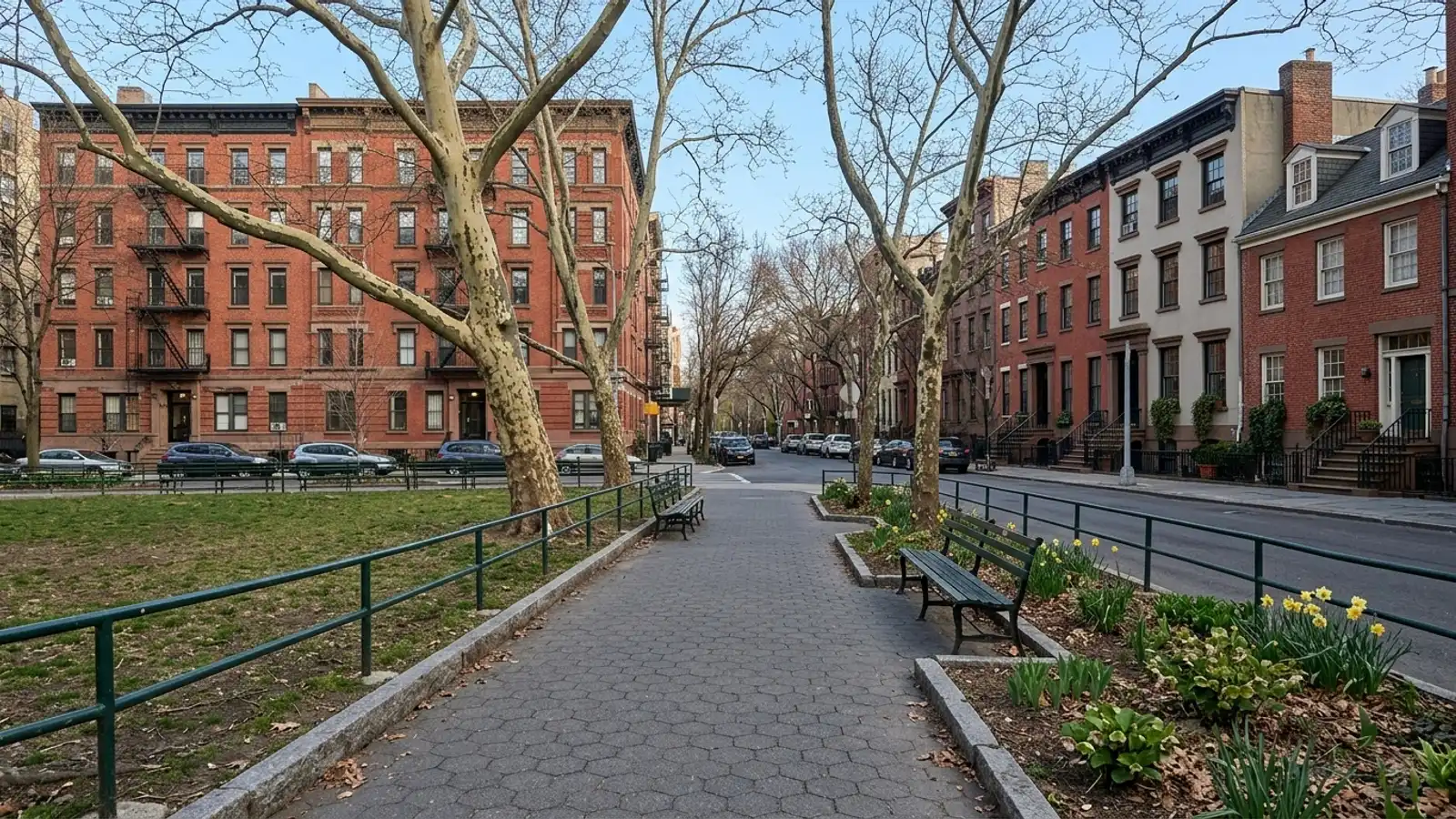
The median home sale price across Manhattan, NY sits around $1,311,000, with properties spending roughly 73 days on the market. Buyers searching in the southern half of the borough tend to end up comparing two of the best neighborhoods in Manhattan: the West Village and the East Village.
They’re not interchangeable. Different building types, different price floors, different subway access – and the right choice depends on your budget, your tolerance for co-op boards, and where you’re heading every morning.
Where the Neighborhoods Begin and End
The West Village sits on the western edge of Lower Manhattan, generally bounded by the Hudson River to the west, 14th Street to the north, Houston Street to the south, and Sixth Avenue to the east. Some definitions push the eastern border to Seventh Avenue or Greenwich Avenue.
The East Village occupies the opposite side of the island – roughly the area east of the Bowery and Third Avenue, south of 14th Street, north of Houston Street, and running all the way east to the East River.
Real Estate Market Prices and Trends
Property values differ between these two sides of Manhattan, and buyers should expect higher baseline costs on the western end. Across Manhattan, average sale-to-list ratios sit just under 100%, meaning most homes sell close to asking. The exact figures vary by zip code, but competitive pricing is the baseline assumption in either neighborhood.
Prices in the West Village
As of mid-2026, median home sale prices in the West Village generally range between $1.2 million and $1.9 million. A May 2026 report noted a median close price of $1.4 million across 19 closed sales in a 30-day period. Active listings during that same period hovered around 109 properties, with a median asking price of $1.9 million.
Condos are where the numbers get serious – median prices reaching between $2.6 million and $4.3 million.
Prices in the East Village
The East Village offers a lower median entry point. In June 2026, the median home sale price was $890,000, representing a decrease from the previous year. The median price per square foot recently sat at $1,284. Condos here are also more expensive than co-ops, with median condo prices ranging from $1.2 million to $1.3 million.
Available Housing Types and Architecture
The physical buildings available for purchase look different depending on which side of the island you’re on. Both neighborhoods feature older construction, but the ownership structures vary in ways that affect your purchase process from day one. A co-op board approval is a different experience than a condo closing, and the inventory in each area will largely determine which process you’re dealing with.
Historic Walk-Ups and Brownstones
The West Village has a relatively small, historic housing stock of about 14,178 units, dominated by pre-war brownstones and walk-ups. The East Village is mostly a rental market – buyers will find pre-war walk-ups and a small number of new developments, but finding something to purchase often means waiting for a unit in an older building to come available.
Co-ops Versus Condos
Co-ops dominate the West Village, making up roughly 61% of active inventory. Recent transaction data shows co-op sales outnumbering condo sales, with co-ops typically priced between $825,000 and $1.5 million.
The East Village has a mix of co-ops and condos as well, though the exact percentage split is less documented. Co-ops there generally offer lower median prices, ranging from $697,000 to $770,000.
Local Amenities and Daily Life
Daily routines in Manhattan depend on what’s within a reasonable walk – parks, groceries, the retail corridors you’ll use. These two neighborhoods cater to different preferences, and honestly, the best way to understand the difference is to walk both on a weekday afternoon.
Dining and Shopping Corridors
In the West Village, Bleecker Street serves as the main commercial corridor, known for high-end boutiques and specialty retail. The East Village spreads its commercial activity across several avenues – cafes, bars, and restaurants along Avenue A, First Avenue, Second Avenue, 7th Street, St. Mark’s Place, and 9th Street – rather than concentrating everything on a single street.
Parks and Green Spaces
Hudson River Park runs along the West Village’s western edge, and several of its most popular piers are located directly in the neighborhood. In the East Village, Tompkins Square Park is the primary green space and, along with St. Mark’s Place, forms the architectural and social spine of the area.
Transit Access and Commuting
Subway access is where the West Village pulls ahead in a practical sense. It’s served by the A, C, E, 1, 2, 3, B, D, F, M, and L lines, plus the PATH train, with specific stations near the West Village Houses offering access to many of those lines.
The East Village relies on four main subway lines running along its borders – the 4, 6, F, and L. Key access points include the 3rd Avenue Station for the L train along 14th Street, the Astor Place Station for the 6 train, and the 2nd Avenue Station for the F train near the Lower East Side border. Workable, but a narrower menu.
Frequently Asked Questions
Which is more expensive, West Village or East Village?
The western side of the island presents a steeper barrier to entry, especially for premium condo inventory. Shoppers looking to stretch their budget often target the eastern section, where the median price per square foot sits at $1,284.
What types of homes are available in West Village vs East Village?
Buyers on the western side usually face a co-op board interview, since those units make up roughly 61% of the active inventory. House hunters on the eastern side need patience, as the local market caters largely to renters and purchase opportunities remain scarce.
How do commute times compare between West Village and East Village?
Residents living near the Hudson River enjoy a much wider menu of transit options, including direct access to the PATH train. Those living on the opposite side of the island must walk to the neighborhood’s borders to reach the nearest station at Astor Place or 14th Street.
Social Cookies
Social Cookies are used to enable you to share pages and content you find interesting throughout the website through third-party social networking or other websites (including, potentially for advertising purposes related to social networking).