

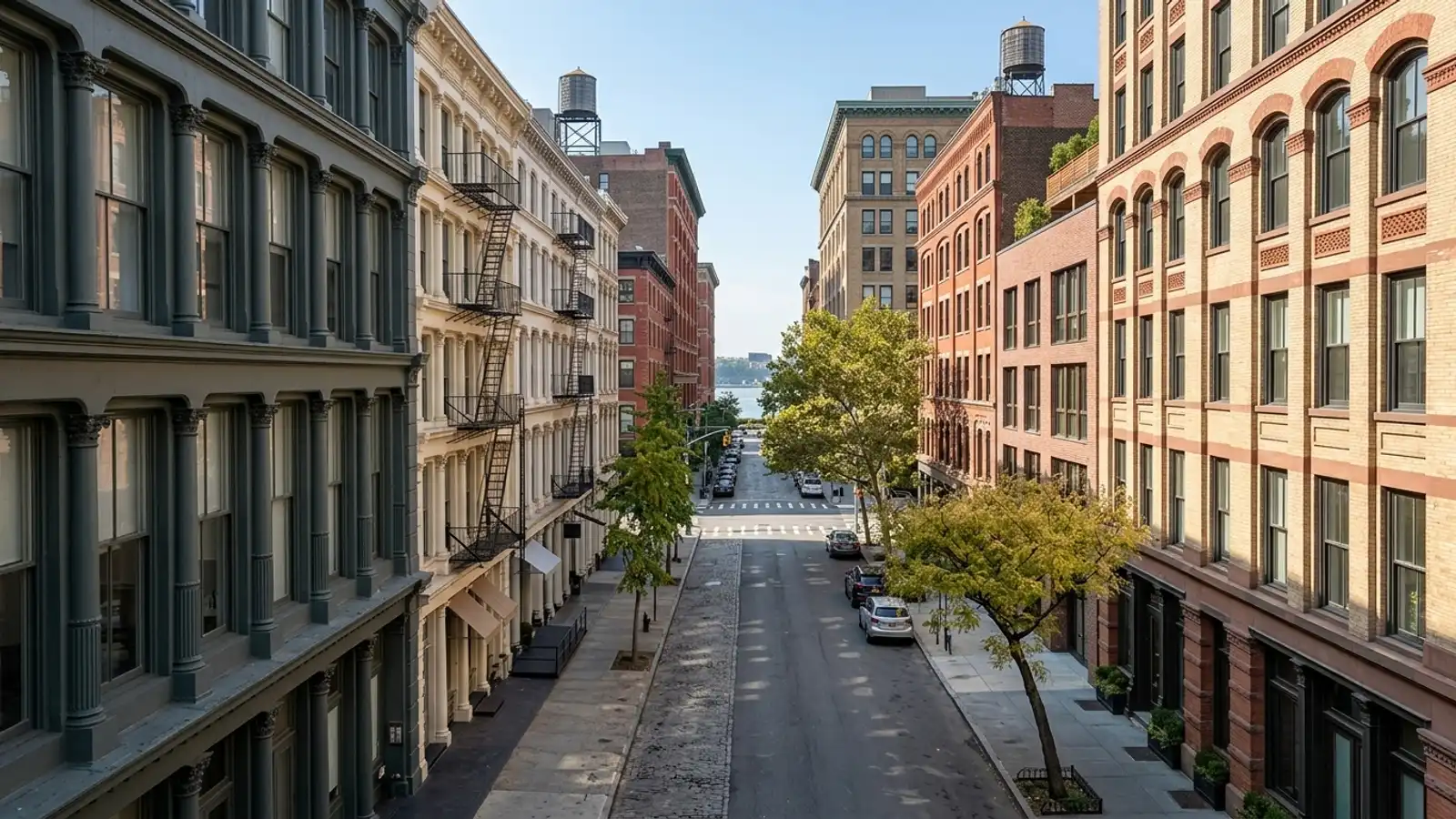
Lower Manhattan is home to some of the most expensive real estate in the United States, with the broader Manhattan median sale price recently sitting around $1.31 million. If your search for the best neighborhoods in Manhattan brings you to the southern end of the borough, you’ll almost certainly find yourself weighing Tribeca against Soho.
Canal Street separates them, but they share a common origin story – warehouses and factories from the 19th and 20th centuries converted into high-end residential lofts. The bones are similar. The details, though, are where these two markets go their separate ways. The differences in housing stock, price points, and historic preservation rules will help you figure out which one fits your goals.
Tribeca and Soho Real Estate Market Data
As of mid-2026, both neighborhoods sit well above the Manhattan median. You’re looking at entry points in the multi-million dollar range either way – but the trajectory of each market has diverged a bit over the past year.
Tribeca is currently running ahead of Soho on overall median sale price. In Q2 2026, Tribeca recorded a median home sale price of $3.9 million, a 4.7% year-over-year increase. Active listing medians in Tribeca are even higher, hovering between $4.5 million and $4.62 million.
Soho saw a dip over the same period. The Q2 2026 median sale price there was $3.5 million – a 10.2% decrease from the previous year. That said, active listing data for Soho shows current medians closer to $3.97 million, so the gap narrows when you look at what’s on the market right now.
Price per square foot is where things get interesting. Soho recently reached a median of $2,108 per square foot, up 5.3% year-over-year. Tribeca sits just behind at $2,030 per square foot, following a 4.5% annual increase. Two neighborhoods with very different headline prices, and yet buyers are paying roughly the same by the foot.
Condominium and Co-op Availability
Ownership structure is one of the starkest contrasts between these two markets. Tribeca is condo-dominant – roughly 4,592 condo units compared to just 1,412 co-op units, which works out to about three condos for every co-op. If you want to avoid a board approval process, Tribeca gives you far more to work with.
Soho flips that ratio. There are approximately 1,919 co-op units against 1,120 condos, meaning co-ops are the majority of what you’ll encounter. If you’re open to a board approval – and comfortable with what that process involves – you’ll have a wider range of inventory in Soho. If you’re not, Tribeca is the more straightforward path.
Housing Styles and Loft Architecture
The industrial-to-residential conversion story plays out in both neighborhoods, but they fall under different preservation frameworks, and that matters when you’re thinking about renovations.
The Landmarks Preservation Commission regulates exterior alterations, demolition, and new construction across landmarked buildings in both areas. That means neither neighborhood gives you a free hand on the outside of your building.
Most of Soho sits within the SoHo-Cast Iron Historic District, originally designated in 1973 and extended in 2010. The LPC requires approval for exterior work – window replacements, facade repairs, roof decks, external air conditioning units, signage. The cast-iron facades that define the neighborhood are precisely what the designation is there to protect.
Tribeca operates under four separate historic districts: Tribeca North, South, East, and West. These were designated between 1991 and 1992, with an extension in 2002. A 2016 effort to expand the districts further was denied by the LPC, which determined the area already had sufficient protection.
If you’re planning significant exterior renovations in either neighborhood, you’ll need a Certificate of Appropriateness from the LPC, and exterior materials will need to closely match historic profiles. Budget time for that process.
Tribeca Lofts and New Construction
Tribeca’s housing stock is a mix of classic warehouse loft conversions and newer luxury developments, and the range is considerable. On one end you have historic loft buildings; on the other, high-profile towers that compete with anything in the city.
Notable properties include the Herzog & de Meuron-designed 56 Leonard Street and Robert A.M. Stern’s 70 Vestry. You’ll also find units at 30 Park Place and 108 Leonard, a McKim, Mead & White conversion. It’s a neighborhood where trophy architecture shows up in more than one era.
Soho’s Cast-Iron Buildings and Rezoning
Soho’s concentration of cast-iron architecture is genuinely distinctive – the high ceilings, large windows, and deep floor plates were designed for manufacturing, and they translate well to residential use. That’s the classic Soho loft, and there’s nothing else quite like it in the city.
The neighborhood is also in the middle of a significant shift following the 2021 rezoning of SoHo and NoHo. Roughly twenty new residential projects are currently filed or underway across Soho, NoHo, and Tribeca – a mix of luxury condos, rentals, and affordable housing. Soho’s supply picture looks different today than it did five years ago.
Neighborhood Amenities and Layout
Daily life in both neighborhoods revolves around dense commercial streets and Lower Manhattan’s infrastructure. Canal Street divides them, but access to the broader downtown core is comparable from either side.
Soho’s layout is tight – compact blocks packed with storefronts, galleries, and restaurants. It’s a major destination for shoppers and tourists, which shapes what the street-level experience feels like on a Saturday afternoon.
Tribeca has wider streets and a less concentrated retail footprint. The tradeoff is proximity to Hudson River Park along the west side of Manhattan. Residents there have direct access to the park’s piers, running paths, and waterfront green spaces – something Soho buyers, situated further inland, don’t have at the same walking distance. Soho puts you closer to the center of downtown’s commercial activity. Tribeca puts you closer to the water.
Comparing Your Downtown Options
Condo or co-op, waterfront or retail corridor, landmark tower or cast-iron loft – those are the decisions you’re making here. Both neighborhoods offer classic loft living in protected historic districts, and both will cost you.
If you want condo ownership and newer luxury construction, Tribeca’s inventory is more accommodating. The co-op board approval process is simply less of a factor there.
Soho is the better fit if you want a classic cast-iron loft and you’re willing to work within a co-op structure. The 2021 rezoning also means new residential supply is coming, so the neighborhood’s options will continue to expand.
Frequently Asked Questions
Which is more expensive, Tribeca or Soho?
Tribeca carries the higher overall median sale price. In Q2 2026, Tribeca’s median was $3.9 million compared to Soho’s $3.5 million. That said, Soho’s median price per square foot was slightly higher – $2,108 versus Tribeca’s $2,030.
What are the main differences in housing styles between Tribeca and Soho?
Soho is defined by its cast-iron historic district and classic manufacturing lofts. Tribeca offers a broader mix – warehouse loft conversions alongside trophy new-development towers like 56 Leonard Street and 70 Vestry.
Are there more condos or co-ops in Tribeca compared to Soho?
Tribeca is condo-dominant, with roughly 4,592 condo units and only 1,412 co-op units. Soho has the reverse setup – approximately 1,919 co-op units and just 1,120 condos.
Is the approval process for renovating a historic loft stricter in Tribeca or Soho?
Both neighborhoods require a Certificate of Appropriateness from the Landmarks Preservation Commission for exterior alterations. Most of Soho falls under the SoHo-Cast Iron Historic District, while Tribeca is covered by four separate historic districts. The regulatory framework is similarly structured in both areas.
Social Cookies
Social Cookies are used to enable you to share pages and content you find interesting throughout the website through third-party social networking or other websites (including, potentially for advertising purposes related to social networking).