

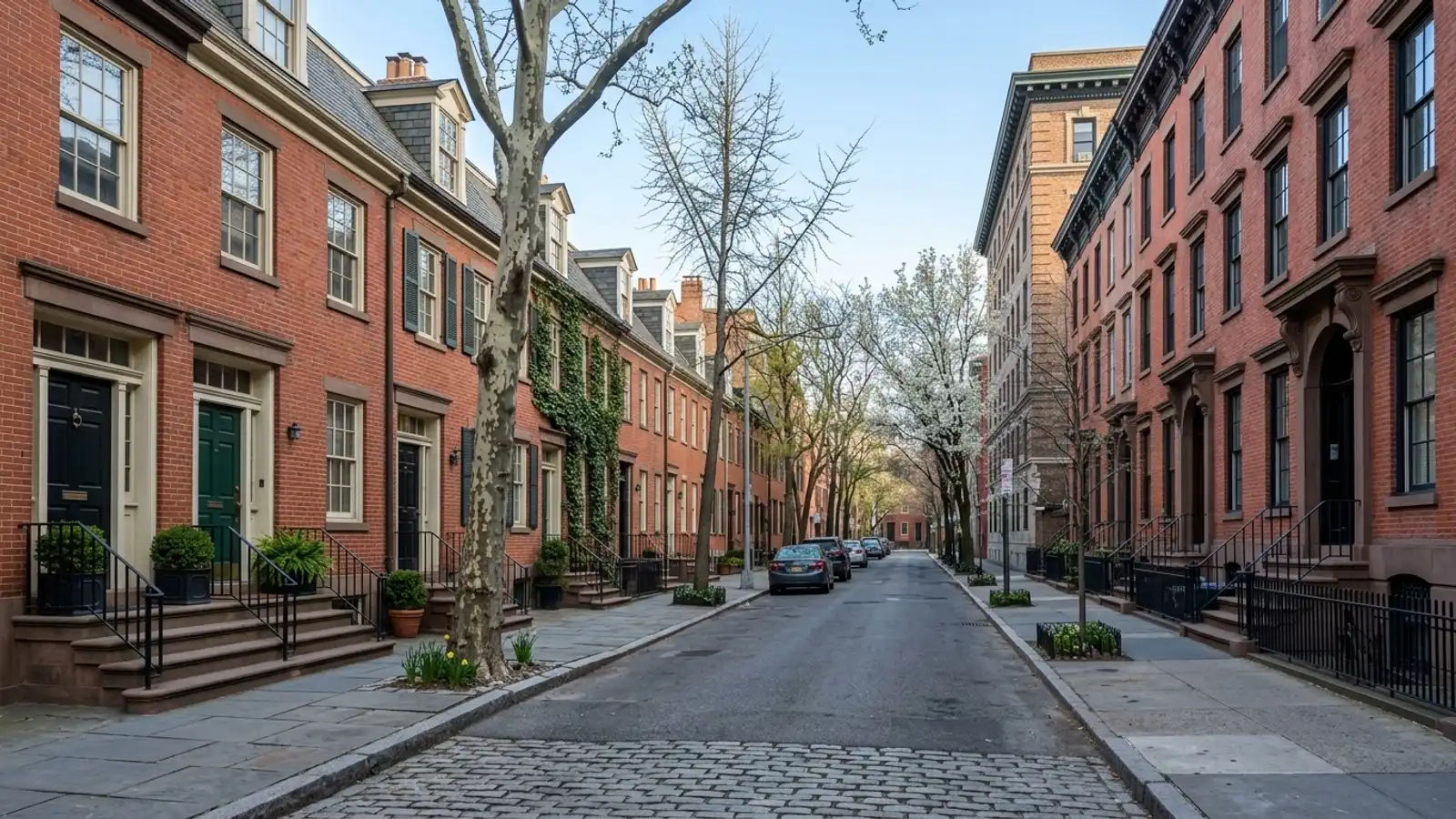
Greenwich Village sits on the west side of Lower Manhattan, and if you’ve spent any time here, you already know it doesn’t feel like the rest of the city. It stands out as one of the best neighborhoods in Manhattan. The street grid breaks apart, the blocks get smaller, and the architecture shifts into something older and more deliberate. The signature landmark is the Washington Square Arch in Washington Square Park – a marble triumphal arch that architect Stanford White designed, completed in 1892 to commemorate the centennial of George Washington’s inauguration. It’s the kind of thing you stop noticing after a while, which is exactly how you know you live somewhere worth living.
Buyers looking at homes for sale in Greenwich Village, Manhattan, will find pre-war co-ops, modern condominiums, and classic townhouses. It functions as a distinct residential enclave inside a very large city, and it pulls that off without asking you to sacrifice transit access or daily conveniences.
Real Estate Prices and Market Trends in Greenwich Village
Currently, the median home sale price across all of Manhattan sits at roughly $1.31 million. Homes average 73 days on market, the borough carries about 4.4 months of supply, and sellers are getting around 99% of their list price. Roughly 13% of properties sell above asking.
Greenwich Village tends to price above those borough-wide numbers. One comparative analysis puts the neighborhood’s median sale price at $1.975 million, against $1.225 million for broader Manhattan. Redfin’s data lands closer to $1.3 million for the Village – more in line with the borough median – which tells you that the spread depends on which property types happened to close during a given timeframe. Both figures are worth knowing.
If you’re tracking the market, sites like Redfin, Homes.com, and Movoto publish neighborhood-specific trend reports worth bookmarking. And before you fall in love with a co-op, research the building’s requirements first. Co-op boards set binding rules on down payments, financing, and subletting, and those rules aren’t negotiable once you’re in contract.
Housing Styles and Property Types
The local housing stock runs the full historic range. Tree-lined blocks carry 19th-century townhouses – some still single-family, others converted into boutique cooperative apartments – and that’s the inventory a lot of buyers come here specifically to find.
If co-op restrictions aren’t appealing, mid-rise and high-rise condominiums give you a different path in. These buildings typically offer modern amenities, elevators, and full-time door staff. They also tend to command higher price points than the co-ops they sit alongside.
Transit, Dining, and Daily Life
Getting around is genuinely one of this neighborhood’s strengths. The 1, 2, and 3 lines run along 7th Avenue, and the West 4th Street station puts the A, B, C, D, E, F, and M lines within easy reach. The L runs under 14th Street along the neighborhood’s northern edge, the R/W (and late-night N) sit along Broadway, and the PATH train stops at Christopher Street for anyone commuting into New Jersey. That’s a lot of options.
Day-to-day errands are walkable. The irregular block structure that makes the Village look complicated on a map works in your favor on foot – it creates a denser concentration of local businesses, independent shops, and everyday services than a standard grid would.
Local Restaurants and Everyday Dining
Dining here covers a real range. MacDougal Street and Greenwich Avenue have the kind of restaurant density that supports actual daily life, not just the occasional night out – casual cafes, neighborhood bakeries, independent coffee shops, established dining rooms. It’s not a monoculture of one type of place.
Independent markets and specialty food shops round things out for cooking at home, so you’re not relying on a single grocery option. That matters more than people realize when they’re deciding where to live.
Schools, Healthcare, and Climate Info
The weather follows what you’d expect from New York City: cold winters that are occasionally snowy, mild springs, warm and humid summers. Nothing unusual for the region.
For medical care, the immediate area has local clinics, urgent care centers, and private practices for everyday needs. Larger hospital systems and specialized facilities are located just outside the neighborhood, within the broader Manhattan network.
New York City Geographic School District 2
Greenwich Village falls within New York City Geographic School District 2, which is a large attendance zone covering several distinct Manhattan neighborhoods. Along with Greenwich Village, District 2 includes the Financial District (FiDi), Chelsea, Tribeca, the West Village, the Upper East Side, Midtown, and Hell’s Kitchen.
Your specific school assignment depends on your building’s address, not just the general neighborhood. Check the district’s official zoning maps before you make assumptions – it matters.
Frequently Asked Questions
What is Greenwich Village in Manhattan known for?
Greenwich Village is known for its historic architecture, non-grid street layout, and the Washington Square Arch. It offers a dense mix of townhouses, co-ops, and daily amenities with extensive subway access.
What are homes like in Greenwich Village Manhattan, and what do they cost?
Homes include 19th-century townhouses, pre-war co-ops, and modern condominiums. Median sale prices range from $1.3 million to $1.975 million depending on the data source, often sitting higher than the overall Manhattan median.
What restaurants and dining are in Greenwich Village Manhattan?
The neighborhood features a mix of independent cafes, bakeries, and restaurants along corridors like MacDougal Street. It provides both casual everyday dining and specialty food markets for residents.
What is the weather like in Greenwich Village Manhattan?
The area experiences a standard Northeastern climate with four distinct seasons. Winters are cold and occasionally snowy, while summers bring warm and humid conditions.
What hospitals and medical care are near Greenwich Village Manhattan?
Residents use local urgent care centers and private clinics for everyday medical needs. Larger hospital systems and specialized care facilities are located in adjacent Manhattan neighborhoods.
Social Cookies
Social Cookies are used to enable you to share pages and content you find interesting throughout the website through third-party social networking or other websites (including, potentially for advertising purposes related to social networking).