

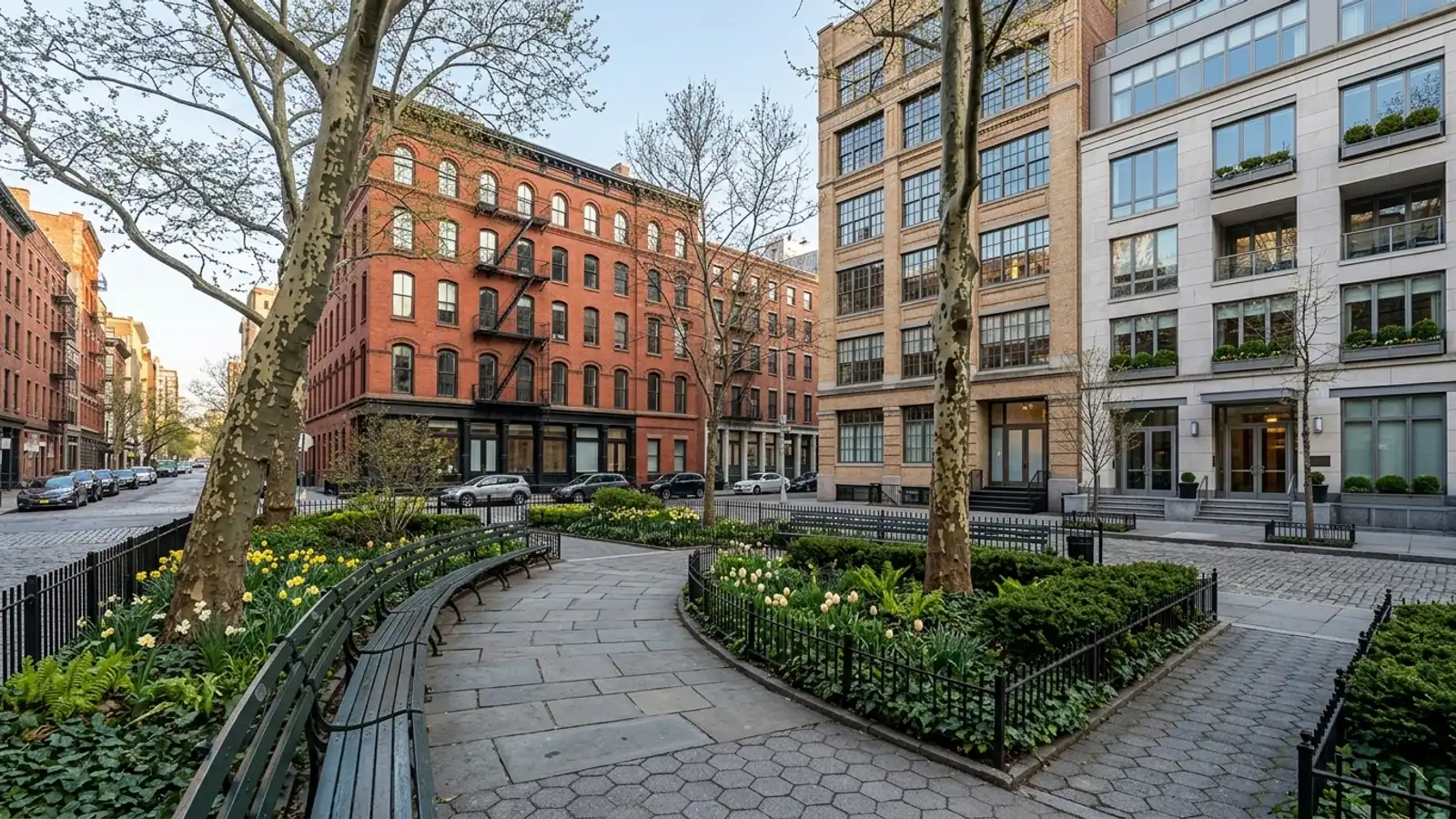
Manhattan breaks down into dozens of neighborhoods, and each one has its own housing personality and price reality. Buyers searching for the best neighborhoods in Manhattan often focus on the lower end of the borough and land on Tribeca – a district built out of converted industrial space, anchored by cobblestone streets, and sitting right up against the Hudson River.
Coming here from the broader Manhattan market requires a mental adjustment. The borough-wide median sale price currently sits around $1.31 million. Tribeca is a different conversation entirely. The housing stock, transit options, and day-to-day lifestyle will tell you fairly quickly whether this neighborhood makes sense for you.
An Overview of Tribeca in Manhattan
Tribeca occupies the lower portion of Manhattan, with the Hudson River forming its western edge. The name is an acronym – “Triangle Below Canal Street” – which tells you exactly where you are historically and geographically.
The district spent decades as an industrial and manufacturing hub before gradually converting into a residential neighborhood. What that transition left behind is a streetscape of cobblestone blocks, low-rise warehouse architecture, and landmarks like the AT&T Long Lines Building, completed in 1932.
Where the Neighborhood Is Located
Tribeca sits in Lower Manhattan with reasonably direct access to the Financial District, SoHo, and Greenwich Village. The Chambers Street subway station is the primary transit anchor for the area, serving the 1 and 2 trains around the clock and the 3 train during most hours except late nights.
That’s a useful connection. Whether you’re heading to Midtown for work or cutting across to Brooklyn, you’re not starting from a difficult position.
Housing Character and Setting
The residential feel here is almost entirely shaped by the historic architecture. Original warehouses converted into expansive apartments produce floor plans you simply won’t find in a standard Manhattan building – high ceilings, industrial bones, and genuine square footage.
One structure worth understanding before you buy is the AT&T Long Lines Building, designed by Ralph Walker. It’s one of the largest Art Deco buildings in the city and carries official New York City Landmark status. That designation reflects a broader preservation ethos in the neighborhood. Tribeca doesn’t look like Midtown, and there are rules in place to keep it that way.
Real Estate and Home Prices in Tribeca
Let’s be direct about where this market sits. Manhattan as a whole saw a median sale price of approximately $1.31 million recently, with homes spending roughly 73 days on the market. Tribeca operates on a different scale entirely.
Data from Quarter 2 of 2026 puts the median home sale price in Tribeca at $3.9 million – a 4.7% year-over-year increase. The median price per square foot came in at $2,030 during that same period. Those numbers reflect both the scarcity of the product and consistent demand for it.
Home Types and Property Attributes
What you’ll find for sale here is primarily loft-style apartments and luxury condominiums. The converted industrial buildings frequently deliver high ceilings, exposed brick, and oversized windows – details that are genuinely rare elsewhere in the city and that hold their value because of it.
One thing buyers sometimes overlook: many of these buildings date to the 19th and early 20th centuries, which means landmark preservation rules and zoning guidelines can affect exterior renovations. If you’re planning to put your own stamp on the place, understand those constraints before you’re under contract.
New Construction Versus Established Lofts
Historic loft conversions dominate the inventory, but new construction does exist here. Newer buildings tend to offer modern condominium layouts with amenities like doormen, fitness centers, and rooftop terraces – a different experience from the raw character of a true loft conversion.
Regardless of which category you’re buying in, budget for monthly common charges or homeowners association fees. They vary based on what the building provides, but they’re part of the cost of ownership in this market.
Dining, Transit, and Daily Life
Most of what residents need day-to-day is accessible without leaving the neighborhood. The concentration of independent businesses keeps errands manageable, and transit connectivity to the rest of Manhattan is strong.
Restaurants and Everyday Dining
The restaurant scene runs from casual cafes and bakeries to high-end dining, and a lot of it is housed in the ground floors of historic buildings – which means the interiors tend to be more spacious than you’d expect compared to other parts of the city.
For groceries, coffee, and quick meals, residents have options within walking distance. It’s not the kind of neighborhood where you’re constantly leaving to handle basic errands.
Getting Around Manhattan
The 1, 2, and 3 trains at Chambers Street handle the bulk of commuting. They run up and down the West Side of Manhattan, which covers a lot of ground efficiently.
If you drive or use car services, proximity to the West Side Highway is a real advantage for getting out of the city or heading north. The street grid down here is less uniform than Midtown, but the wide avenues keep things workable.
Practical Information: Schools, Healthcare, and Climate
Infrastructure matters when you’re making a purchase at this price point. School zones, medical access, and even how the weather hits this particular part of the city are worth understanding before you commit.
Climate follows the general New York City pattern – four distinct seasons, warm and humid summers, cold winters. The Hudson River proximity does add something: wind off the water that you’ll notice more here than a few blocks inland.
School Districts Serving Tribeca
Tribeca falls within New York City Geographic District No. 2, a district that also covers the Financial District, Chelsea, the West Village, and the Upper East Side. The primary zoned public elementary school for the neighborhood is P.S. 234, located roughly a 10-minute walk from the Hudson River.
School zoning is specific, and it’s worth verifying your exact address against current district maps before making assumptions.
Medical Care and Hospitals
The closest major acute-care facility is NewYork-Presbyterian Lower Manhattan Hospital at 170 William St, approximately 0.3 miles away. That hospital serves the Financial District, SoHo, Little Italy, and the Lower East Side.
Further out, NYU Langone Hospitals at 550 1st Ave and NYC Health + Hospitals/Bellevue at 462 1st Ave round out the nearby options for more specialized care.
Finding a Home in the Neighborhood
With a median sale price of $3.9 million, financing and down payment strategies need to be worked out before you’re seriously shopping – not after you’ve found something you want. The inventory moves, and showing up unprepared costs you.
The market includes both cooperative apartments and condominiums, and the buying process differs meaningfully between them. Co-ops require board approval and financial disclosures. Condominiums are a more straightforward transaction. Knowing which you’re targeting shapes the entire timeline.
Buying Versus Renting
Renting first is a reasonable approach if you’re new to the neighborhood. It gives you time to understand which blocks and building types suit how you live – cobblestone streets near the river feel different from the avenues closer to City Hall, and that difference matters day-to-day.
For buyers who are ready, the 4.4 months of supply across Manhattan signals a balanced but active environment. Properties priced accurately with authentic loft details don’t sit long.
Working With a Local Agent
Someone who knows Tribeca specifically – not just Manhattan generally – is worth finding. Price per square foot analysis here requires context, and building financials on co-ops and condos vary widely enough that you want someone who’s read a lot of them.
A local agent also moves you through the board package process, coordinates inspections, and keeps the closing timeline from getting away from you. That’s not a small thing in a building-approval market.
Frequently Asked Questions
What is Tribeca in Manhattan known for?
Tribeca is known for its historic architecture – specifically its large-scale industrial loft conversions – along with cobblestone streets, Hudson River proximity, and landmarks like the Art Deco AT&T Long Lines Building, completed in 1932.
What are homes like in Tribeca Manhattan, and what do they cost?
The inventory is primarily historic loft conversions and modern luxury condominiums. As of Quarter 2 2026, the median home sale price was $3.9 million, with a median price per square foot of $2,030.
What restaurants and dining are in Tribeca Manhattan?
Options range from casual cafes and bakeries to larger restaurants occupying historic ground-floor commercial spaces. Everyday grocery shopping, coffee, and varied dining are all available within walking distance.
What is the weather like in Tribeca Manhattan?
Four distinct seasons: warm, humid summers and cold winters. The Hudson River border means residents get noticeable breezes off the water throughout the year.
What hospitals and medical care are near Tribeca Manhattan?
The closest acute-care facility is NewYork-Presbyterian Lower Manhattan Hospital, 0.3 miles away at 170 William St. NYU Langone Hospitals and NYC Health + Hospitals/Bellevue are both on 1st Avenue for additional options.
What are the public and private school options for families moving to Tribeca, Manhattan?
The neighborhood is zoned within New York City Geographic District No. 2. The primary zoned public elementary school is P.S. 234, a short walk from the Hudson River.
What landmark restrictions should buyers be aware of when buying and renovating a historic loft in Tribeca, NY?
Many buildings carry historic preservation protections, including official New York City Landmark designations like the AT&T Long Lines Building. Exterior renovations on historic lofts are subject to local zoning and landmark guidelines – understand those constraints before you close.
Social Cookies
Social Cookies are used to enable you to share pages and content you find interesting throughout the website through third-party social networking or other websites (including, potentially for advertising purposes related to social networking).