

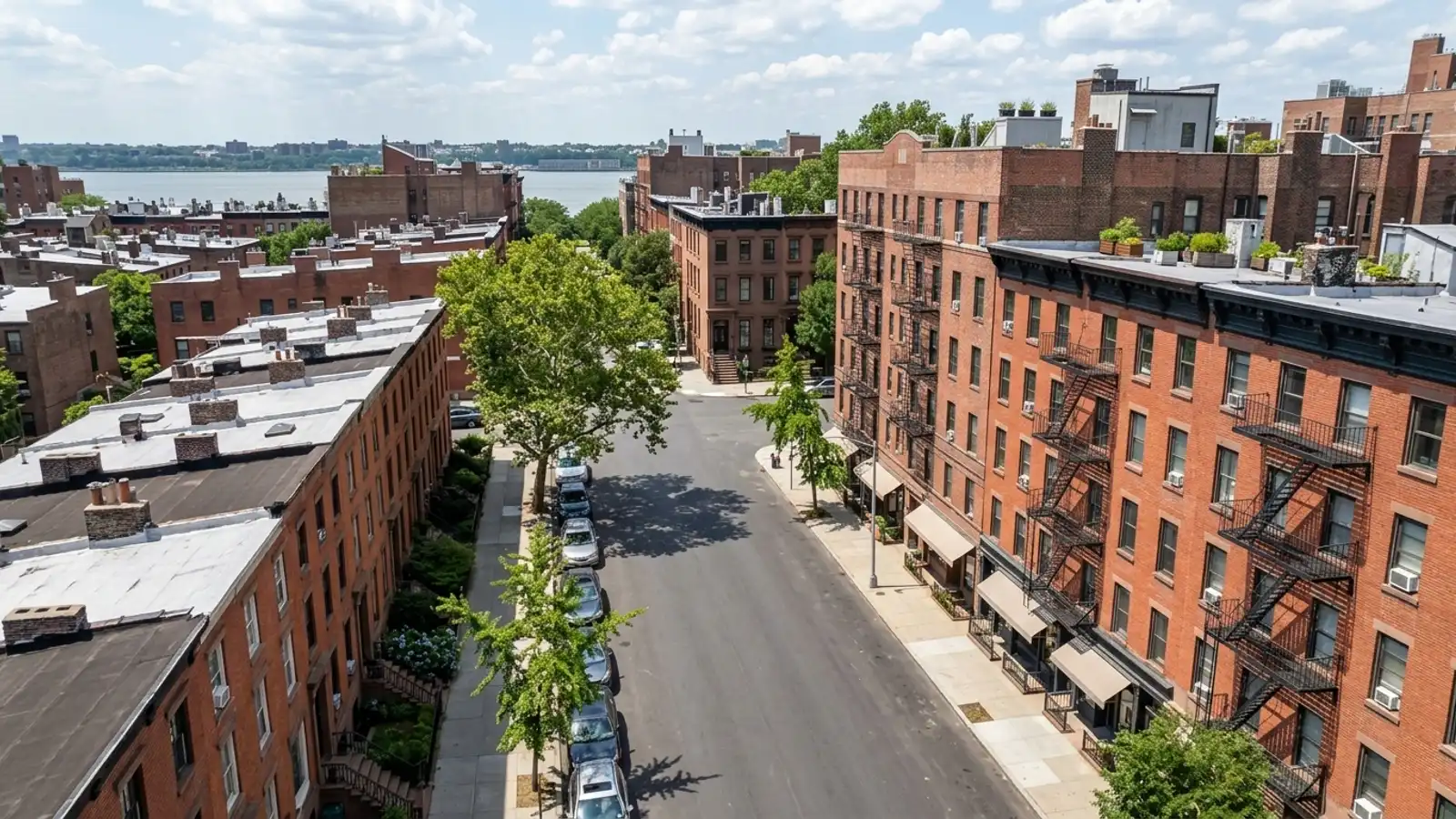
The West Village sits along the lower west side of Manhattan, NY, and the first thing you’ll notice – even before you look at a single listing – is that the streets don’t behave. The grid that governs almost every other part of the borough simply doesn’t apply here. You get angles, triangular blocks, intersections that don’t make immediate sense, and a scale that feels genuinely different from the rest of the city. That distinct character is exactly why it remains one of the best neighborhoods in Manhattan for buyers.
Buying here means paying for that difference. While the Manhattan median sale price runs around $1.31 million, West Village properties typically land between $1.6 million and $1.8 million. That gap isn’t an accident – it reflects supply that’s genuinely constrained and demand that doesn’t soften much.
What to Expect in West Village, Manhattan
The most recognizable landmark is The Stonewall Inn at 53 Christopher Street – a National Historic Landmark and the site of the 1969 Stonewall Riots, which marked the beginning of the modern LGBTQ+ rights movement. That history is woven into the neighborhood’s identity in a way that’s hard to overstate.
The angled street layout isn’t just a quirk. It creates a neighborhood that feels self-contained, even though you’re a short walk from Chelsea to the north, the Hudson River to the west, and Soho to the south.
Neighborhood Layout and Housing Setting
You won’t find glass towers here. The housing stock is attached townhouses, low-rise apartment buildings, and historic co-ops – brick facades, tree-lined blocks, fire escapes running up the front of buildings. The scale keeps sunlight on the streets and the density lower than what you’d find in adjacent areas.
That’s not a small thing in Manhattan. It’s part of what people are paying for.
Fitting Into the Wider Manhattan Landscape
The West Village forms the western portion of the larger Greenwich Village area. It borders Chelsea to the north, the Hudson River to the west, and Soho to the south – which means you’re sitting right next to some of the city’s most trafficked commercial zones, while the residential blocks themselves stay relatively quiet. It’s a useful combination.
The Real Estate Market in West Village
Prices here are among the highest in the city, and the inventory to match your budget isn’t always sitting there waiting for you. The median home sale price in the West Village runs roughly between $1.6 million and $1.8 million, depending on the month and what type of property you’re looking at.
For context, the broader Manhattan market recently saw a median sale price of about $1,311,132, with homes spending an average of 73 days on the market. In the West Village, well-priced units move faster than that.
Home Types and Property Styles
Most of what you’ll find is pre-war co-ops, converted townhomes, and a small number of newer boutique condominiums. Single-family townhouses do come up occasionally, but they’re rare and they price well above the neighborhood median.
A lot of the buildings don’t have elevators. Walk-up apartments make up a significant share of the inventory, and the units themselves tend toward the smaller side – exposed brick, original hardwood floors, layouts that reflect early 20th-century construction rather than modern open-plan preferences. That’s the trade-off you’re making.
Pricing and Market Dynamics
Manhattan-wide inventory recently hovered around 4,105 available homes, with a 4.4-month supply. The West Village runs tighter than that. The average sale-to-list ratio across Manhattan sits at 99.37%, which tells you sellers aren’t taking haircuts – and that’s for the broader market, not specifically for a neighborhood where supply is as constrained as it is here.
Strong offers matter. Renovated units and buildings with low monthly maintenance fees attract real competition.
Co-ops, Condos, and Associations
The majority of what’s available in the West Village is co-ops. When you buy a co-op, you’re not buying real estate directly – you’re purchasing shares in a corporation, and that corporation owns the building. Board approval is required for every purchase, and the financial requirements are thorough.
Condominiums are simpler: fewer restrictions on subletting, a more straightforward buying process. They’re also less common here and tend to cost more than comparable co-ops. Whichever route you’re considering, you’ll need to factor in the monthly maintenance or HOA fees alongside the purchase price. That number matters more than buyers sometimes expect.
Dining, Transit, and Daily Life
Everyday convenience isn’t something you’ll have to compromise on. The ground-floor commercial density means most things you need are within a block or two, and the dining options in this neighborhood are genuinely well-regarded citywide – not just by the people who live here.
Driving is the wrong choice for this neighborhood. The angled streets disorient people unfamiliar with them, street parking is scarce, and the subway handles the actual commuting work well enough that most residents don’t miss a car.
Everyday Dining and Local Restaurants
The list of established spots here is long: Via Carota, I Sodi, The Little Owl, Minetta Tavern, Buvette, Don Angie, 4 Charles Prime Rib, Corner Bistro, Waverly Inn, and Boucherie West Village. These aren’t just destination restaurants drawing people in from other neighborhoods – they’re what locals eat at on a regular basis.
Independent coffee shops, bakeries, and specialty grocers fill in the gaps. Day-to-day life here is well-supplied.
Getting Around and Public Transit
The primary subway access is the 1 train at the Christopher Street – Sheridan Square station. The West 4th Street – Washington Square station gives you the A, C, and E lines. For Brooklyn or the East Side, the L train is accessible at 8th Avenue along the neighborhood’s northern edge.
Midtown and the Financial District are both short, direct rides. For most people who live here, that’s all they need.
Schools, Healthcare, and Weather
There are practical infrastructure questions that come up with every buyer, and in the West Village they’re worth addressing directly. The neighborhood sits within a large public school district and has immediate access to specialized medical care. The climate is standard New York City – which means you need to plan for both ends.
Local School Districts
The West Village falls within New York City’s Community School District 2, which covers a substantial portion of lower and midtown Manhattan – Greenwich Village, Chelsea, Tribeca, and the Upper East Side among them. School assignments depend on your exact address, not just the general area.
For specific attendance-zone maps and enrollment rules, the New York City Department of Education website is where you’ll need to look. It changes, and the details matter.
Hospitals and Medical Care
The primary hospital serving the area is Northwell Greenwich Village Hospital at 30 7th Avenue. It reopened on the former St. Vincent’s Medical Center site as an inpatient facility with upgraded cardiac care, and it operates as the only hospital serving Manhattan’s Lower West Side.
For additional specialized services, the facility coordinates with Lenox Hill Hospital and Manhattan Eye, Ear & Throat Hospital.
Climate and Seasonal Weather
July is the hottest month, with average highs of 84°F and lows of 70°F. January is the coldest, with average lows of 29°F and highs reaching 40°F. Spring and fall are genuinely pleasant for walking – temperatures move from the low 50s in March through the mid-70s in September and October.
It’s a four-season city. Pack accordingly.
Investment Properties and Short-Term Rentals
If you’re looking at the West Village as an investment property or a pied-à-terre, the short-term rental picture here is worth understanding before you get too far into your strategy. New York City has binding regulations on this, and they apply directly to homes for sale in West Village, Manhattan.
Local Law 18 and Rental Rules
Under NYC’s Local Law 18, which took effect in 2023, hosts must register with the Mayor’s Office of Special Enforcement. Without registration, listings can’t be booked through platforms like Airbnb or Booking.com.
The law limits rentals under 30 days to a maximum of two guests, and the host must be physically present in the unit during the stay. Whole-apartment short-term rentals are effectively prohibited.
Rental Income Context
Because of those rules, investors here focus on long-term traditional leases – tenants on agreements of 30 days or more. Co-op boards add another layer: many restrict subletting entirely or cap it at a few years over a buyer’s ownership period.
If long-term rental income is part of your plan, condominiums are the more practical target. They generally allow leasing with fewer board restrictions than co-ops impose.
How to Find a Home in the Area
Manhattan’s market moves quickly, and knowing where inventory lives matters. StreetEasy, owned by Zillow, is the dominant portal for New York City – local agents use it to track listings, and it has deeper integration with NYC inventory than national platforms. Zillow, Redfin, and Homes.com will show you some listings, but StreetEasy is where you should be spending your time.
Renting Versus Buying
Renting avoids the high closing costs and the co-op board approval process. It also keeps you flexible. The trade-off is that West Village Manhattan homes for rent carry steep monthly premiums – demand is high and vacancy rates are low, so flexibility doesn’t come cheap.
Buying locks in your housing costs and builds equity in a market that has historically held its value. How long you plan to stay in the city, and whether you can meet co-op financial requirements, is what drives that decision.
Working with a Local Agent
A local agent is worth more here than in most markets. The co-op board package process requires detailed financial disclosures, and someone who’s been through it repeatedly knows what boards are looking for and what trips people up.
They’ll also catch things that aren’t obvious from a listing – the difference between a fairly priced condo and a co-op with underlying building problems, or what a monthly maintenance fee reflects about the building’s financial health. Submitting an offer without that clarity is an expensive way to learn.
Frequently Asked Questions (FAQ)
What is West Village in Manhattan known for?
The neighborhood is known for its angled street grid, historic townhouses, and low-rise brick architecture. It also holds historical significance as the home of The Stonewall Inn at 53 Christopher Street, the birthplace of the modern LGBTQ+ rights movement following the 1969 Stonewall Riots.
What are homes like in West Village Manhattan, and what do they cost?
Homes consist primarily of pre-war co-ops, walk-up apartments, and historic townhomes. As of 2026, the median home sale price in the neighborhood sits roughly between $1.6 million and $1.8 million, which is higher than the broader Manhattan median of $1.31 million.
What restaurants and dining are in West Village Manhattan?
The area features numerous established dining spots, including Via Carota, I Sodi, The Little Owl, and Minetta Tavern. Locals also frequent Buvette, Don Angie, 4 Charles Prime Rib, Corner Bistro, Waverly Inn, and Boucherie West Village.
What hospitals and medical care are near West Village Manhattan?
Northwell Greenwich Village Hospital at 30 7th Avenue serves as the primary facility for the Lower West Side. It offers inpatient care and upgraded cardiac services, coordinating with Lenox Hill Hospital and Manhattan Eye, Ear & Throat Hospital for additional needs.
How difficult is the co-op board approval process when buying an apartment in the West Village?
The process requires detailed financial disclosures and board approval for all purchases. Co-op boards have the authority to approve or deny buyers, and they often enforce rules regarding subletting and long-term rentals.
Are short-term rentals and Airbnbs allowed for investment properties in West Village, Manhattan?
No, whole-apartment short-term rentals are not permitted. Under NYC’s Local Law 18, hosts must register with the city, be present in the unit during the stay, and limit rentals to a maximum of two guests for stays under 30 days.
What are the main public transit options for commuting from the West Village to other parts of NYC?
The neighborhood is served by the 1 train at the Christopher Street – Sheridan Square station and the A, C, and E lines at West 4th Street – Washington Square. The L train is also accessible at 8th Avenue on the northern edge of the neighborhood.
Social Cookies
Social Cookies are used to enable you to share pages and content you find interesting throughout the website through third-party social networking or other websites (including, potentially for advertising purposes related to social networking).